
Set Theory
Set notation, Venn diagrams, union, intersection, and complement — excludes permutation/combination counting (see counting-combinations) and pure probability (see probability)
Generate Unlimited Practice Questions
Sign up for free and get 50 practice questions to start your prep.
Start Free PracticeLearn This Topic
Imagine you and your best friend are ordering a pizza. You want pepperoni, and your friend wants mushrooms. To make you both happy, you order a half-pepperoni, half-mushroom pizza, but you ask the chef to put extra cheese all over the whole thing! 🍕
In math, we call groups of things "Sets." Your pizza toppings are a set, and your friend's toppings are a set. Set Theory is just a fun way of organizing these groups to see what they have in common.
On the ISEE, you will see a lot of "Venn diagrams." These are those cool overlapping circles. - The Intersection is the overlapping middle part. It’s what BOTH sets share (like the extra cheese you both wanted). - The Union is EVERYTHING in both circles combined (pepperoni, mushrooms, and extra cheese).
The ISEE Quantitative Reasoning section loves to test if you can figure out how many kids play sports, or how many pets are in a store, by using these overlapping groups. The biggest trick is to make sure you don't accidentally count the same thing twice! Let's learn the secret formula to solve these puzzles like a pro. 🕵️♂️
Practice Questions
4 practice questions for ISEE Lower Level
Show Solution
- An even number is an integer that is divisible by 2. The numbers must also be less than 10.
Let's list the positive even numbers:
2, 4, 6, 8, 10, 12, ...Now, we only want the ones that are less than 10:
2, 4, 6, 8So, set is .
Show Solution
- This problem asks for the number of students who like fantasy books mystery books, which is the union of the two sets.
Let be the set of students who like fantasy books, so .
Let be the set of students who like mystery books, so .
The number of students who like both fantasy mystery books is . This is the intersection of the two sets, .
To find the number of students who like fantasy mystery books (), we use the formula:
Substitute the given values:
So, 19 students like to read fantasy or mystery books.
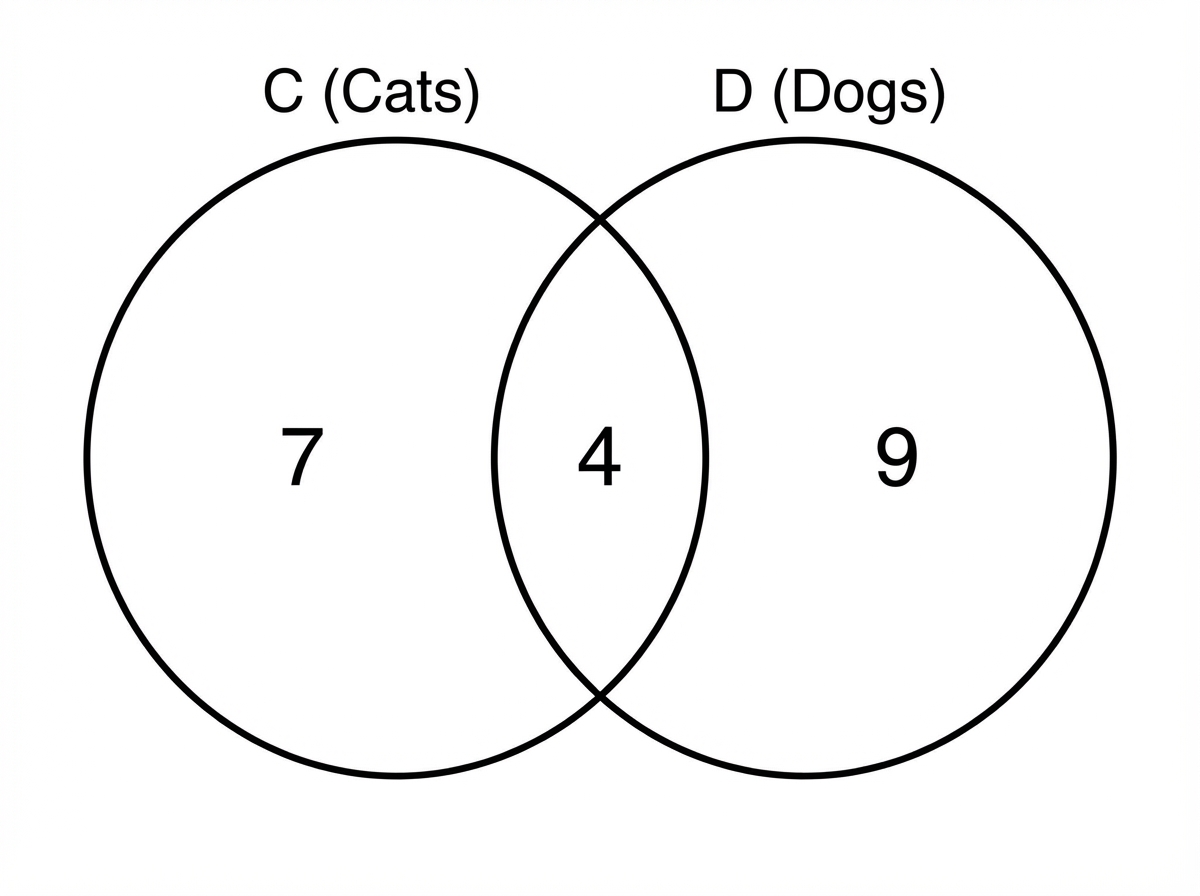
In the Venn diagram:
- The circle for (Cats) has children who own only cats.
- The overlapping region between and has children.
- The circle for (Dogs) has children who own only dogs.
How many children own both cats dogs?
Show Solution
- The question asks for the number of children who own both cats dogs. In a Venn diagram, the region that represents 'both' is the overlapping part of the circles. This region is called the intersection.
Based on the description:
- children own only cats (this is part of circle but outside the overlap).
- children are in the
overlapping regionbetween and . This represents children who own both cats dogs.- children own only dogs (this is part of circle but outside the overlap).
Therefore, children own both cats and dogs.
Show Solution
- This problem involves finding the complement of a set. The universal set is all the students in the cooking class, which is students.
Let be the set of students who baked cookies. So, .
We want to find the number of students who did bake cookies, which is the complement of set (denoted as or ).
To find the number of students who did not bake cookies, we subtract the number of students who did bake cookies from the total number of students:
Number of students who did not bake cookies = Total students - Number of students who baked cookies
Number of students who did not bake cookies =
Number of students who did not bake cookies =
So, 13 students did not bake cookies that day.
Tips & Strategies
- Draw it out! If an ISEE question gives you a word problem about two groups but no picture, draw your own Venn diagram. Two overlapping circles can make a confusing problem super easy to see.
- Work from the inside out. When filling in a Venn diagram, always write the number for the "Both" (intersection) section first, then figure out the rest!
Common Mistakes
- Watch out for the "Double Count" trap! If a problem says "15 kids play soccer and 10 play tennis," you can't just add to find the total. Some of those soccer players might also play tennis. Always look for the "Both" group and subtract it!
Frequently Asked Questions
What does the word "Complement" mean in Set Theory?
Think of it as the "opposite." The complement of a set is everything that is NOT in that set. If Set A is "all the dogs," the complement is every animal that is not a dog!
Will the ISEE ask me about more than two overlapping circles?
For the Lower and Middle Level ISEE, you will usually only see two circles. The Upper Level might occasionally sneak in three, but the same rules apply—just work from the very center overlap outwards!
What if I completely blank on a Venn diagram question during the test?
Guess! The ISEE has absolutely no penalty for wrong answers. If you are stuck, eliminate any answers that seem way too big or way too small, pick your favorite letter, and move on.