
Angles
Angle relationships (supplementary, complementary, vertical), parallel line angles, and interior angle sums of polygons
Generate Unlimited Practice Questions
Sign up for free and get 50 practice questions to start your prep.
Start Free PracticeLearn This Topic
Have you ever opened a fresh pizza box and noticed how the slices meet in the middle? Those pointy corners are angles! 🍕 In geometry, angles measure how far apart two lines are opened up. Imagine a crocodile opening its mouth—a little bite is a small angle, and a big chomp is a large angle! 🐊
On the SSAT, Angles and Lines are like a giant puzzle. You just need to know a few secret rules to solve them. First, a straight line is always . If you split a straight line into two angles, they are called "supplementary" angles. Think of them as two best friends who always share a skateboard halfpipe! If two lines cross each other like an "X" on a treasure map, the angles opposite each other are exactly the same size. We call these "vertical angles." ✖️
What about shapes? A triangle is like a folded-up straight line—all its inside angles always add up to . If you add one more side to make a quadrilateral (like a square, rectangle, or a funky kite), the inside angles will always add up to . Think of as doing a full spin on a snowboard! 🏂
If you remember these magical numbers ( for corners, for lines and triangles, and for full circles and 4-sided shapes), you will absolutely crush the geometry questions on your SSAT! You don't need a protractor, just your awesome math skills! Let's dive in!
Practice Questions
4 practice questions for SSAT Middle Level
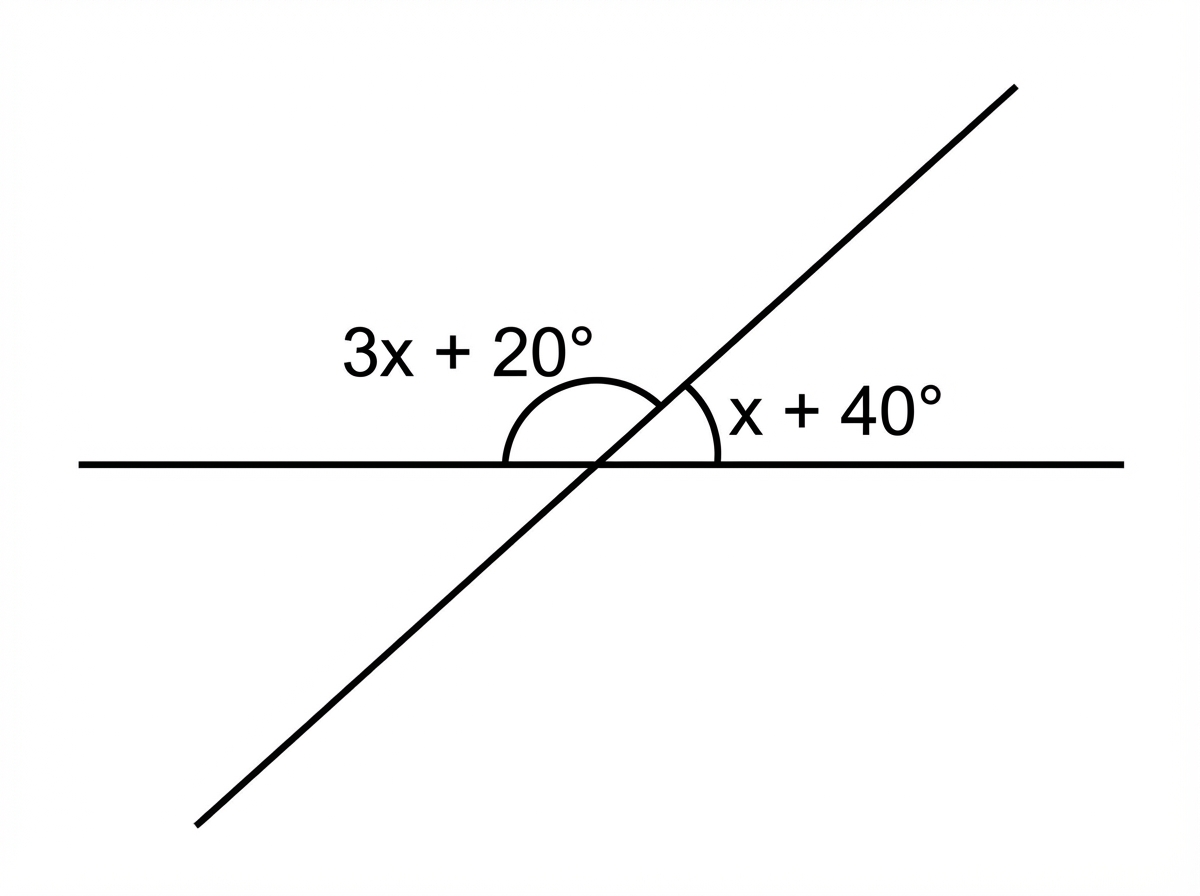
Show Solution
- Adjacent angles formed by intersecting straight lines are supplementary, meaning their sum is degrees. Set up the equation: . Combine like terms to get . Subtract from both sides to get , and divide by to find .
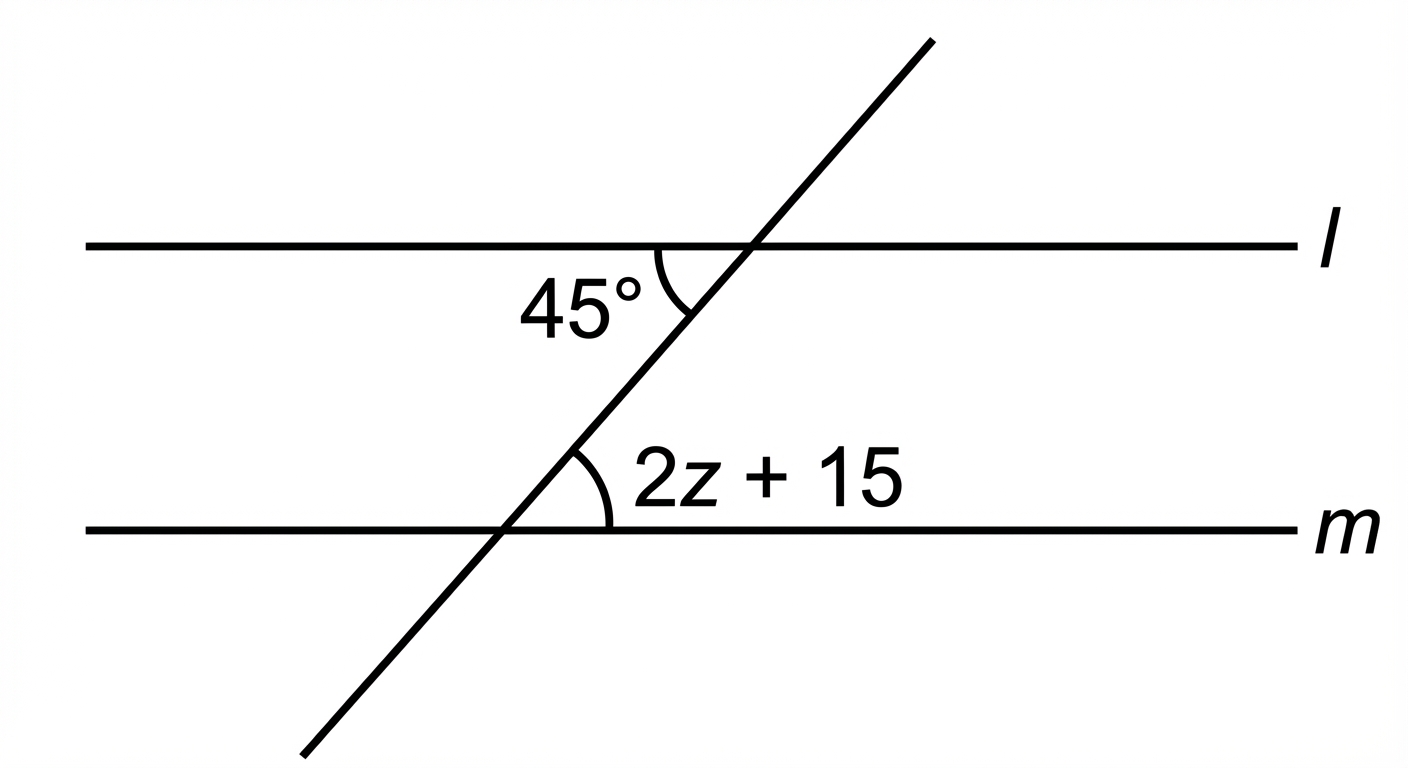
Show Solution
- When parallel lines are cut by a transversal, any acute angle and any obtuse angle formed are supplementary (they add up to degrees). Therefore, . Combining the numbers gives . Subtracting from both sides leaves . Dividing by gives .
Show Solution
- Angles that form a straight line add up to degrees. Set up the equation: . Combine the terms to get . Dividing both sides by gives . The question asks for the largest angle, which is . Multiply by to get degrees.
Show Solution
- The sum of the interior angles of a triangle is always degrees. Let the third angle be . The second angle is . Set up the equation: . Combine like terms to get . Subtract from both sides to get , so . The three angles are , , and . The largest of these is degrees.
Tips & Strategies
- Look for the 'Z' pattern! When you have parallel lines, draw a giant 'Z' over them. The angles tucked inside the corners of the 'Z' are always equal (these are called alternate interior angles).
- Don't trust your eyes! SSAT pictures are usually 'not drawn to scale.' An angle might look like a tiny slice of pie (like ), but the math might say it's . Always trust the numbers, not the drawing.
Common Mistakes
- Watch out for mixing up 'Supplementary' and 'Complementary'. A great trick: 'C' comes before 'S' in the alphabet, and comes before . Complementary = , Supplementary = !
- Don't forget that a triangle has inside, but a 4-sided shape has . Many students accidentally try to make a square's angles add up to !
Frequently Asked Questions
Do I need to bring a protractor for the SSAT?
Nope! You are actually not allowed to use a protractor on the test. You will solve all angle questions using math rules (like addition and subtraction), not by measuring them.
What exactly is a vertical angle?
When two straight lines cross like an X, the angles directly across from each other are vertical angles. Think of them as mirror images—they are always exactly the same size!
How do I remember the angles of bigger shapes like pentagons?
Use the magic formula! Subtract 2 from the number of sides, then multiply by . For a 5-sided pentagon, it's .
What if a question asks for half of a supplementary angle?
First, remember that supplementary angles add to . If you need exactly half of that straight line, you would calculate !