
Triangles
Triangle area, Pythagorean theorem, angle sums, congruence, and similarity — excludes general area/perimeter of other shapes (see area-perimeter-composite)
Generate Unlimited Practice Questions
Sign up for free and get 50 practice questions to start your prep.
Start Free PracticeLearn This Topic
Imagine grabbing a perfect slice of pizza. It’s not just delicious; it’s the best shape ever—a triangle! Triangles are secretly hiding everywhere in our world, from sandwich halves in your lunchbox to giant skateboard ramps and even the ancient pyramids in Egypt. 🍕
On the SSAT, triangles are definitely VIPs (Very Important Polygons). But what makes a triangle a triangle? Every triangle has three straight sides and three inside angles. Here is the golden rule: those three inside angles always, always, always add up to exactly . Think of it as a strict dress code at the Triangle Club. If your angles add up to or , the bouncer won't let you in! 📐
There’s another wild rule you need to know called the Triangle Inequality Theorem. It says that if you add the lengths of the two shortest sides of a triangle, the total must be bigger than the longest side. If they aren't, the sides won't be able to reach each other to close the shape, kind of like a drawbridge that falls short over a castle moat. Finally, keep an eye out for "Right Triangles" (triangles with a perfect corner, like the corner of a book). They use a magic spell called the Pythagorean Theorem to find missing sides. Master these fun shapes, and you'll completely crush the geometry questions on your SSAT! 🦸♂️
Practice Questions
3 practice questions for SSAT Middle Level
Show Solution
- The sum of the interior angles of any triangle is . Because the angles are in the ratio 2:3:4, we can represent their measures as , , and . Adding them together gives , which simplifies to . Solving for gives . The largest angle is , so we multiply: .
Show Solution
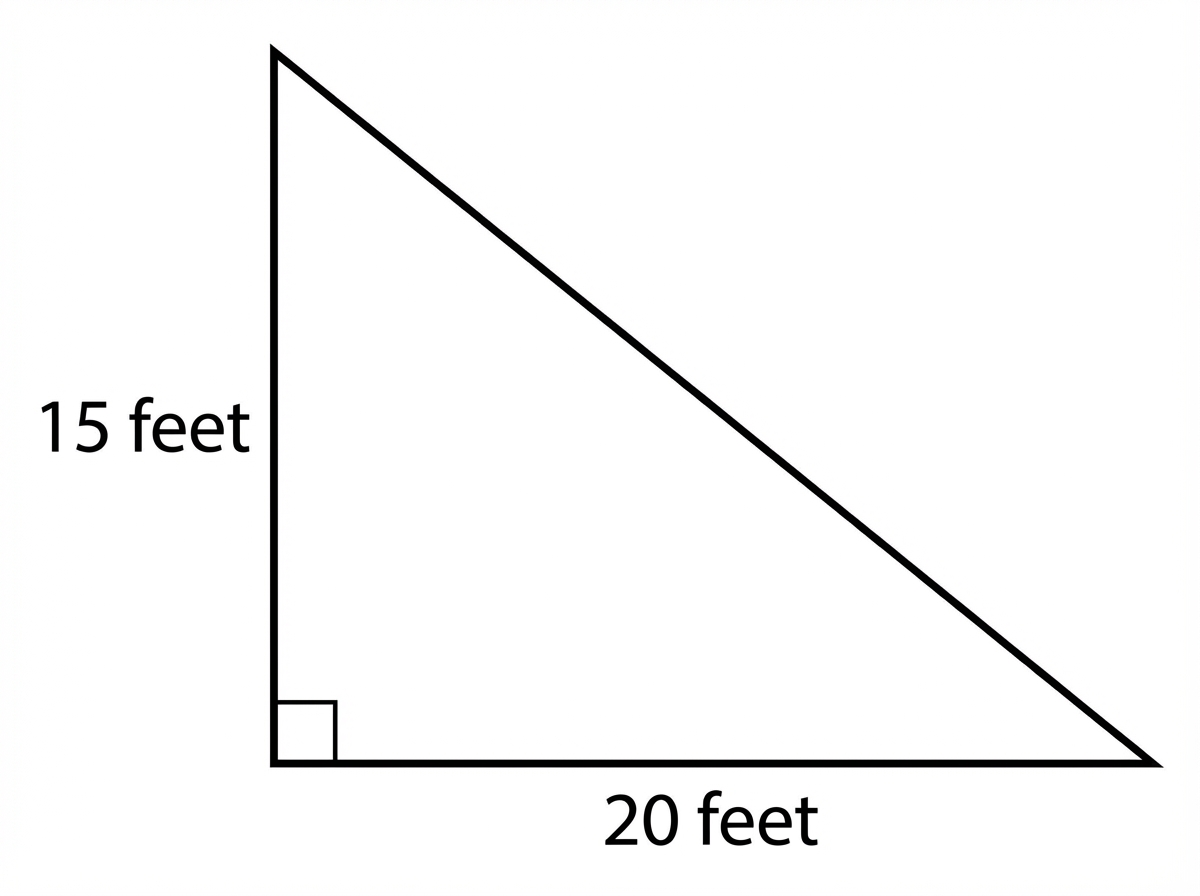
- First, find the length of the longest side (the hypotenuse) using the Pythagorean theorem: . Plugging in the given sides gives , which is . Since , the hypotenuse is 25 feet. To find the length of the fence needed to enclose the garden, calculate the perimeter by adding all three sides together: feet.
Show Solution
- The sum of the interior angles in any triangle is . In an isosceles triangle, the two base angles are equal in measure. First, subtract the vertex angle from the total angle sum: . Since the two base angles are equal, divide this remaining measure by 2 to find the measure of just one base angle: .
Tips & Strategies
- Memorize common 'Pythagorean Triples' like and . If you see a right triangle with legs and , you instantly know the hypotenuse is without doing any math! ⚡
- If an SSAT question asks about the third side of a triangle, always check the Triangle Inequality rule. The third side must be smaller than the sum of the other two sides, and larger than their difference.
- Draw it out! If the test describes a triangle but doesn't give you a picture, sketch it on your scratch paper. Seeing the shape makes finding the missing angles or sides much easier. ✏️
Common Mistakes
- 🚨 Watch out for assuming a triangle is a right triangle just because it looks like one! Unless the problem puts a little square in the corner (the symbol) or tells you it's a right triangle, you cannot use .
- Don't forget that the hypotenuse is ALWAYS the longest side. If you calculate and it's smaller than or , double-check your math!
Frequently Asked Questions
Do I need to memorize area formulas for triangles on the SSAT?
Yes! The area of a triangle is very important. Always remember the formula , where is the base and is the height.
What does 'congruent' mean?
Congruent is just a fancy math word for 'exactly the same.' If two triangles are congruent, their sides and angles are perfectly identical, like twins!
Will the SSAT give me the formulas I need?
Nope! Unlike some other tests, the SSAT does not give you a formula sheet. You'll need to memorize important rules like the Pythagorean Theorem and the angle rule before test day.
What is a 'similar' triangle?
Similar triangles have the exact same shape, but different sizes. Think of it like zooming in or out on a picture on a smartphone. Their angles match perfectly, and their sides grow or shrink by the same fraction.