
Polygons
Properties of quadrilaterals, regular polygons, and symmetry
Generate Unlimited Practice Questions
Sign up for free and get 50 practice questions to start your prep.
Start Free PracticeLearn This Topic
Imagine you're designing a brand new video game level or building a super cool treehouse. You are going to need shapes! In math, we call flat, closed shapes with straight sides "polygons." The word sounds fancy, but "poly" just means "many" and "gon" means "angles." 🎮
Triangles, squares, pentagons (like a baseball home plate!), and hexagons (like a honeycomb) are all awesome examples of polygons. If a shape has a curved side, like a pizza slice, or is open and doesn't close all the way, it's not a polygon! 🍕
Polygons come in two main flavors: regular and irregular. "Regular" polygons are the ultimate rule-followers. All of their sides are the exact same length, and all their angles are the exact same size—like a perfect red stop sign. "Irregular" polygons are wild and wacky, with sides and angles of all different sizes! 🛑
You'll also see a lot of "quadrilaterals" on the ISEE. That's just a big word for a shape with exactly 4 sides. Rectangles, squares, parallelograms, and trapezoids are all part of the quadrilateral family. On the ISEE, the Quantitative Reasoning section loves to test your logic by comparing the sides, angles, and lines of symmetry (where you can fold a shape perfectly in half) of these polygons. Just remember their names and rules, and you'll be a geometry master! 🏰📐
Practice Questions
3 practice questions for ISEE Middle Level
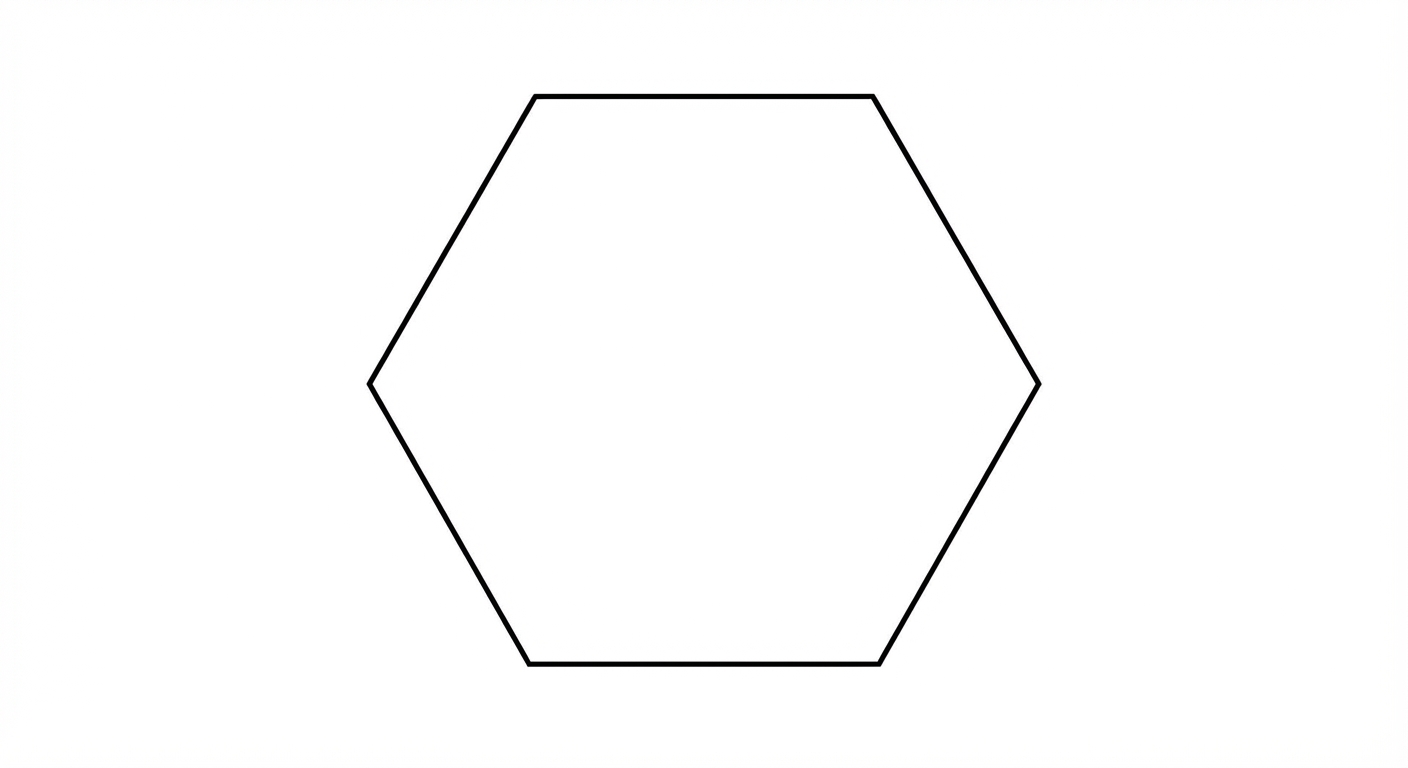
Show Solution
- The sum of interior angles of a polygon with sides is . For a hexagon, : .
Show Solution
- A trapezoid has exactly one pair of parallel sides. When the non-parallel sides (legs) are equal in length, the trapezoid is called an isosceles trapezoid. A parallelogram has two pairs of parallel sides, a rhombus has all four sides equal, and a rectangle has all right angles — none of these fit the description.
Show Solution
- For a regular polygon with sides, each interior angle measures . Set this equal to 135°: . Multiply both sides by : . Subtract : . Divide by 45: . The polygon is a regular octagon.
Tips & Strategies
- Memorize your polygon names up to 10 sides! (Triangle=3, Quadrilateral=4, Pentagon=5, Hexagon=6, Heptagon=7, Octagon=8, Nonagon=9, Decagon=10).
- In Quantitative Comparison questions, look for shortcuts! A hexagon clearly has more sides than a quadrilateral, so its interior angles will always add up to a bigger number. You don't even need to do the math to know Column B is bigger! ⏱️
- If an ISEE question says a shape is 'regular,' immediately write down that all sides and angles are equal. That word is usually the secret key to solving the problem!
Common Mistakes
- Watch out for confusing 'interior' and 'exterior' angles. Interior angles are inside the shape, and their sum grows as the shape gets more sides. Exterior angles (outside) always add up to , no matter how many sides the polygon has!
- Don't forget that a square is a special type of rectangle, and a rectangle is a special type of quadrilateral. Sometimes the ISEE tries to trick you with these shape families!
Frequently Asked Questions
Do I need to memorize the formula for diagonals?
It is super helpful! The formula is . If you forget it during the test, don't panic! You can just draw the shape, then carefully draw and count the lines connecting the corners.
What happens if I don't know the answer on the ISEE?
Guess! The ISEE has absolutely no penalty for wrong answers. If you're stuck on a tricky polygon question, pick your favorite letter and move on. Never leave a bubble blank! ✏️
Are circles considered polygons?
Nope! Polygons must have straight sides. Since a circle is completely curved, it doesn't count as a polygon. 🍕
What exactly does 'regular' mean in geometry?
It means the shape is perfectly balanced. Every single side is the exact same length, and every single angle inside is the exact same size. Think of a perfect stop sign, which is a regular octagon.