
Coordinate Geometry
Plotting points, distance, midpoint, and slope on the coordinate plane — excludes graphing linear equations (see linear-graphing)
Generate Unlimited Practice Questions
Sign up for free and get 50 practice questions to start your prep.
Start Free PracticeLearn This Topic
Imagine a giant treasure map 🗺️ or a fun game of Battleship. That's exactly what the coordinate plane is! It is a grid made of two main lines: the x-axis (which goes left to right, like running across a soccer field) and the y-axis (which goes up and down, like climbing a tree). Every single point on this map has its own special address, written like (x, y).
When you plot a point, remember the golden rule: you always have to walk across the field (x) before you can climb the tree (y)! So for the point (3, 4), you walk 3 spaces right, and climb 4 spaces up.
On the ISEE, you get to be an explorer. You might need to find the distance between two spots (like your house and the pizza shop 🍕), find the exact middle point to meet a friend (that's called the midpoint), or figure out how steep a hill is (that's called slope).
Don't worry, you don't need to memorize a million confusing rules for the ISEE Math Achievement or Quantitative Reasoning sections. Coordinate geometry is really just about counting spaces on a grid and making simple triangles. Let's dive in and find some treasure! ⭐
Practice Questions
3 practice questions for ISEE Middle Level
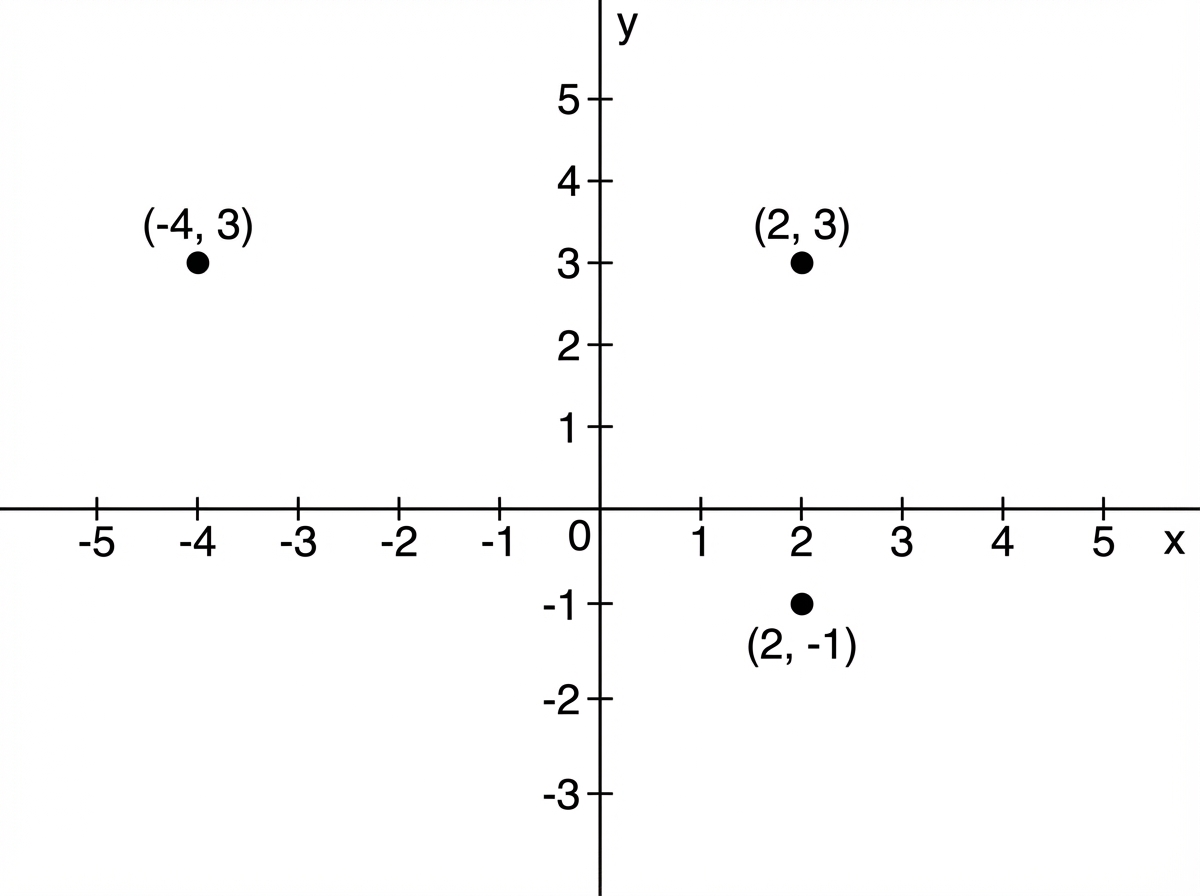
(2, 3), and . What are the coordinates of the fourth vertex of the rectangle?(2, 3) Show Solution
- A rectangle has opposite sides that are parallel to the x-axis and y-axis. The given vertices form a horizontal segment from to at , and a vertical segment from to at . To complete the rectangle, the fourth vertex must align vertically with and horizontally with . Therefore, the coordinates of the fourth vertex are .
(3, 3) (3, 7) Show Solution
- Moving 6 units to the right means adding 6 to the x-coordinate: . Moving 2 units down means subtracting 2 from the y-coordinate: . The new coordinates for the character are
(3, 3).
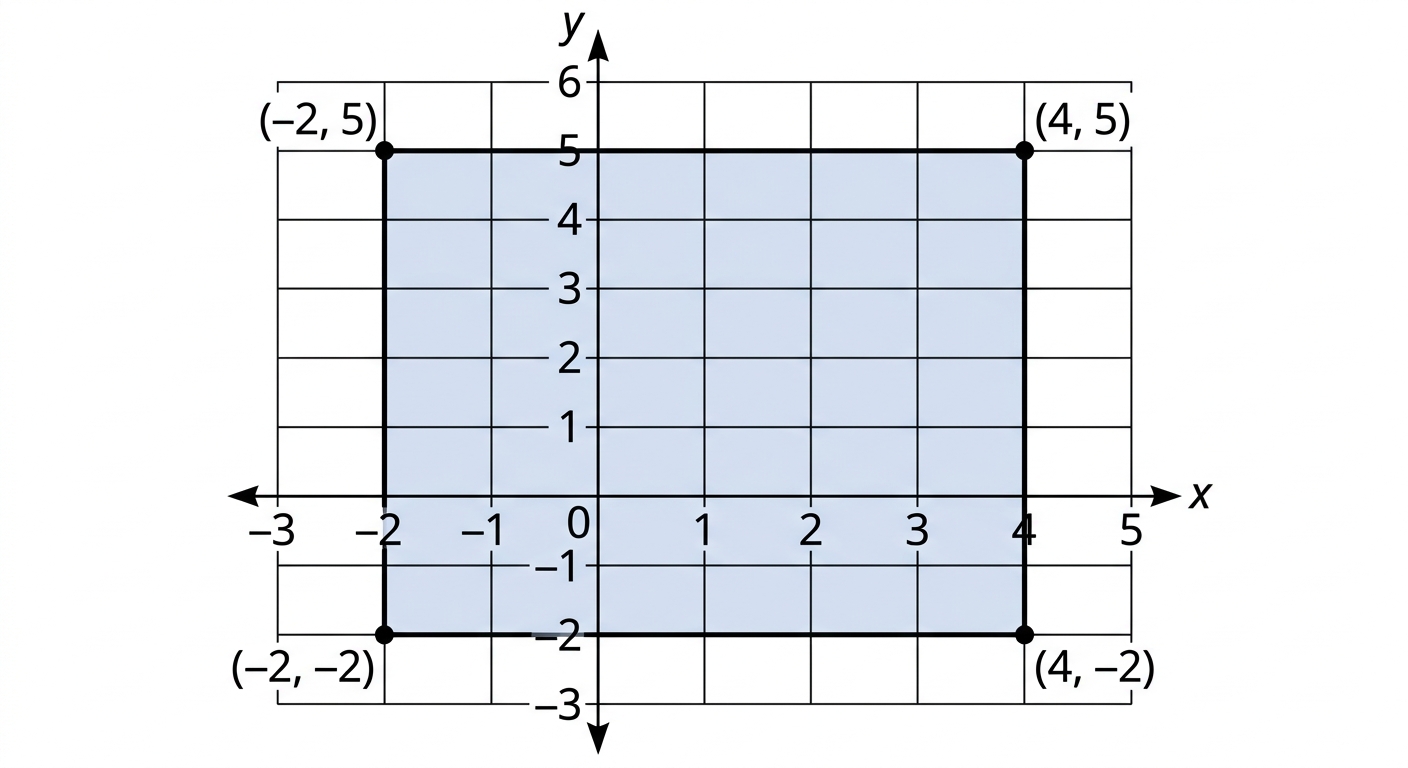
(4, 5), and . If each unit on the grid represents 1 kilometer, what is the area of the park?Show Solution
- First, find the length and width of the park. The horizontal distance (length) from to is kilometers. The vertical distance (width) from to is kilometers. The area of a rectangle is length multiplied by width, so the area is square kilometers.
Tips & Strategies
- Always remember 'Run before you Jump!' When plotting a point
(x, y), go left or right on the x-axis first, then go up or down on the y-axis. - For distance questions, don't panic if you forget the big distance formula. Just sketch a quick right triangle on your scratch paper and use the Pythagorean theorem ().
- In Quantitative Comparison questions, if you're comparing slopes, quickly sketch the points! Sometimes you can literally see which line is steeper without doing any math at all.
Common Mistakes
- Watch out for swapping your x and y coordinates! Writing
(y, x)instead of(x, y)will put you in a completely different spot on the map. - Don't forget that slope is 'rise over run' (). A common mistake is flipping it upside down and doing run over rise!
Frequently Asked Questions
Do I need to memorize the huge distance formula for the ISEE?
Not really! The distance formula is actually just the Pythagorean theorem in a fancy disguise. If you can find the length and height of a triangle on the grid, you can find the distance.
What if a point has a negative number, like ?
No problem! A negative x-number just means you walk left instead of right. A negative y-number means you climb down instead of up.
Is there a penalty if I guess on a hard coordinate geometry question?
Nope! The ISEE does not punish you for wrong answers. If you get stuck, pick your favorite letter and move on. Never leave a bubble blank!
What's the difference between Quantitative Reasoning and Math Achievement on the ISEE?
Quantitative Reasoning asks you to think outside the box and compare values (like the Column A vs. Column B questions). Math Achievement is more straightforward math, like finding an exact midpoint.