
Graphs & Tables
Reading, interpreting, and extracting information from bar graphs, line graphs, pie charts, histograms, frequency tables, two-way tables, schedules, and other structured data displays
Generate Unlimited Practice Questions
Sign up for free and get 50 practice questions to start your prep.
Start Free PracticeLearn This Topic
Imagine trying to explain your favorite video game stats using only a giant, messy wall of numbers. Boring, right? That's exactly why we have graphs! Graphs are like picture books for math. They take a bunch of confusing data and turn it into cool pictures so we can see what's going on instantly.
Bar graphs use tall buildings (bars) to compare things, like who ate the most pizza at a party 🍕. Line graphs connect the dots to show a story over time, like how tall your puppy grows each month 📈. And pie charts? They are literally sliced up like a delicious pizza to show parts of a whole!
On the ISEE, you'll get to be a data detective. You'll look at these pictures and answer questions about them. The secret is to always read the labels first! If you know what the picture is showing, the math is usually a piece of cake 🍰. Let's learn how to read these graphs like a pro so you can grab those easy points on test day!
Practice Questions
4 practice questions for ISEE Middle Level
| Stem | Leaf |
|---|---|
| 1 | 8 |
| 2 | 0 2 5 5 8 |
| 3 | 1 4 4 6 7 9 |
| 4 | 0 2 5 8 9 |
| 5 | 0 0 |
4 | 2 represents a score of 42.How many students scored greater than 35 on the quiz?
Show Solution
- To find the number of students who scored greater than 35, count the leaves that represent a number larger than 35. In the "3" row, the leaves 6, 7, and 9 represent scores of 36, 37, and 39 (3 students). All scores in the "4" row (5 students) and the "5" row (2 students) are also greater than 35. The total number of students who scored greater than 35 is .
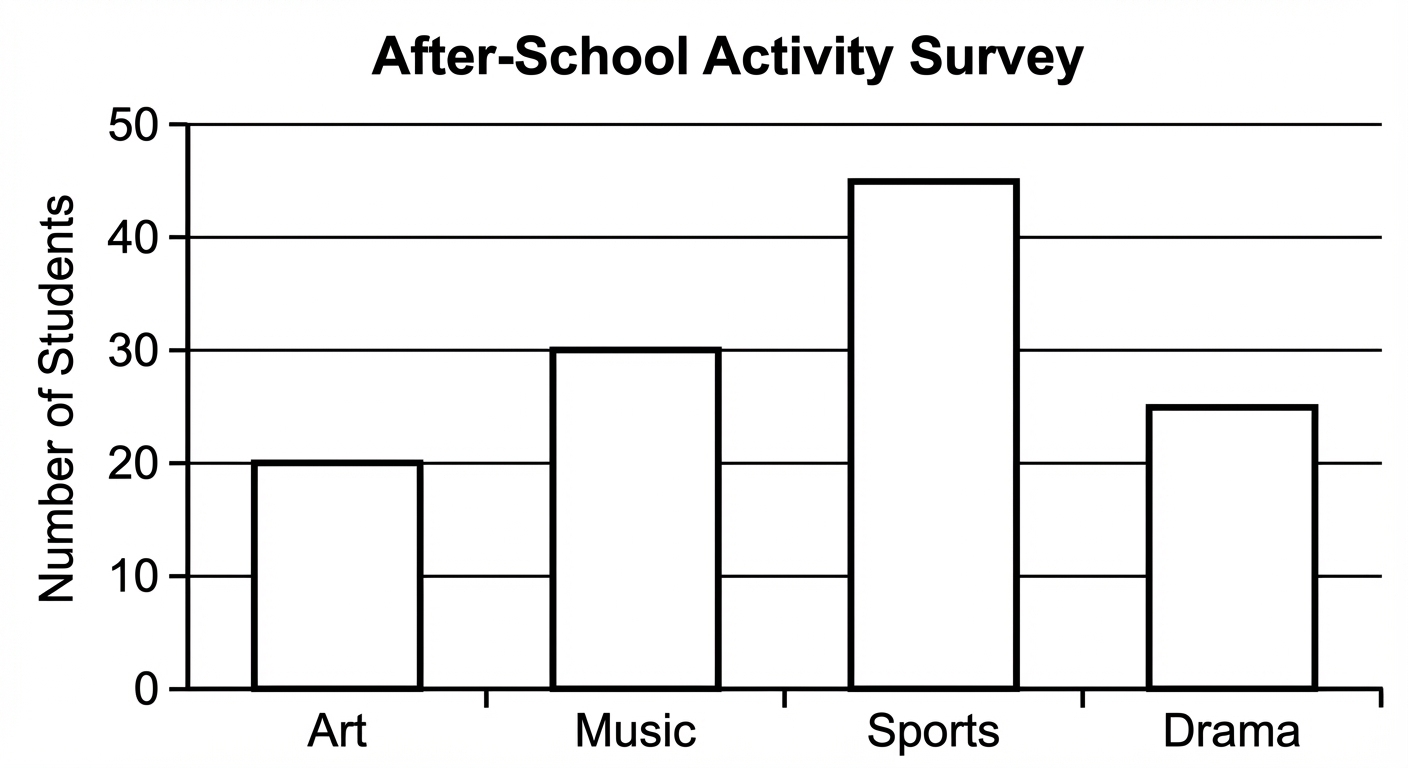
How many more students chose Sports than chose Music?
Show Solution
- According to the bar graph, 45 students chose Sports and 30 students chose Music. The difference is students.
| School | East | West |
|---|---|---|
| Percent of School Surveyed | 10% | 25% |
| Number of YES votes | 15 | 40 |
| Number of NO votes | 5 | 10 |
The results above can be used to predict how many students will vote for and against the dress code when all students at both schools vote.
Show Solution
- For East School, the 15 YES votes represent 10% of the total school. To find the predicted total YES votes, multiply by 10 (since ). The predicted YES votes for East School is . For West School, the 40 YES votes represent 25% of the total school. To find the predicted total YES votes, multiply by 4 (since ). The predicted YES votes for West School is . Since 160 is greater than 150, the quantity in Column B is greater.
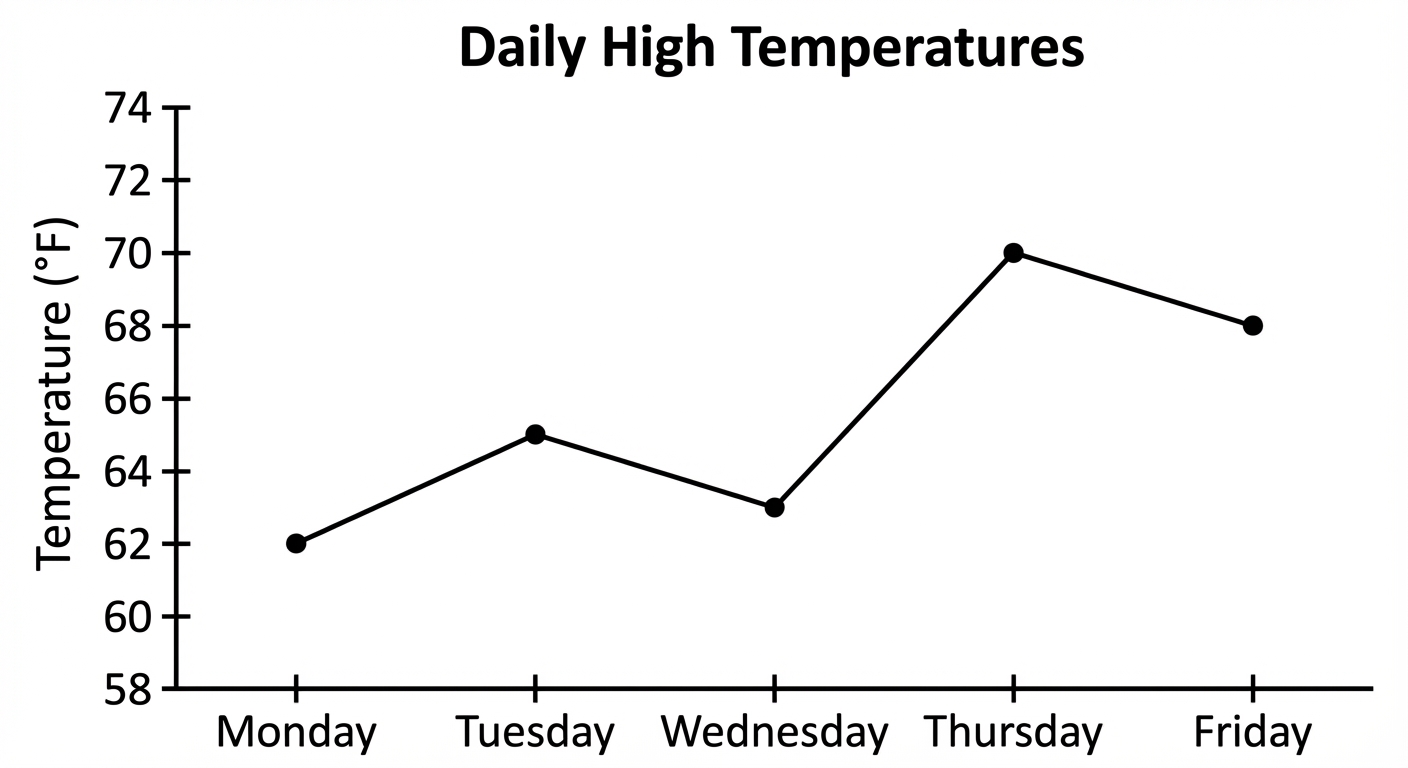
Between which two consecutive days did the temperature increase the most?
Show Solution
- Reading the high temperature for each day from the line graph: Monday = 62°F, Tuesday = 65°F, Wednesday = 63°F, Thursday = 70°F, Friday = 68°F. Calculate the change between each consecutive pair of days: Mon→Tue: , Tue→Wed: (decrease), Wed→Thu: (increase), Thu→Fri: (decrease). The greatest increase was from Wednesday to Thursday.
Tips & Strategies
- Always read the title and labels first! The ISEE loves to trick you by changing the units. If the side of the graph says 'in thousands', the number 5 actually means 5,000.
- Use your pencil as a ruler. If a bar graph is hard to read, line up your pencil from the top of the bar straight across to the numbers on the side to see exactly where it lands.
- Pay close attention to the 'key' or 'legend'. If a pictograph shows a drawing of a book, make sure to check if one drawing equals 1 book, 5 books, or 10 books!
Common Mistakes
- Watch out for skipping the labels! A common mistake is just looking at the shape of the graph and guessing the answer without reading what the numbers actually represent.
- Don't forget that a pie chart must always add up to (or ). If you're missing a slice, just subtract all the other slices from the total to find the missing piece!
Frequently Asked Questions
Do I need to draw my own graphs on the ISEE?
Nope! The ISEE is entirely multiple-choice. You will only need to read and understand graphs that are already drawn for you.
What is a histogram? It sounds like a weird historical telegram!
Haha, it's actually just a special type of bar graph! Histograms group numbers into ranges (like ages 10-14, 15-19) and the bars touch each other to show that the numbers flow continuously without breaks.
What if I can't tell exactly where a line graph point is?
On the ISEE, the correct answer will usually be obvious enough that you can estimate safely. If a point looks exactly halfway between 10 and 20, it's safe to estimate it as 15!
Are graph questions in the Quantitative Reasoning or Mathematics Achievement section?
You can find them in both! In Quantitative Reasoning, you might compare the data in two graphs. In Mathematics Achievement, you'll usually do calculations like finding a fraction or an average from the graph.