
Visual & Spatial Reasoning
Non-coordinate spatial reasoning: net folding, cube counting/painting, paper folding, figure rotation recognition, and 3D visualization — excludes coordinate-based transformations (see transformations)
Generate Unlimited Practice Questions
Sign up for free and get 50 practice questions to start your prep.
Start Free PracticeLearn This Topic
Have you ever played Minecraft, built a massive Lego fortress, or tried to fit a giant leftover pizza box into a tiny trash can? 🍕 If so, you are already a master at Visual and Spatial Reasoning!
Spatial reasoning is just a fancy way of saying 'playing mind movies.' It is the ability to look at a flat picture and imagine what it looks like in real 3D life. On the ISEE, you will see some super fun puzzles in the Quantitative Reasoning section that test this exact skill. 🧠✨
Instead of crunching numbers, you might be asked to fold a flat piece of paper into a cube (called a 'net'), count how many blocks are in a hidden stack, or figure out what a shape looks like after it spins around. It is basically mental gymnastics! 🤸♂️
The secret trick? You do not need a magical 3D brain to get these right. You just need to look for clues! For example, if a box has a star on top and a smiley face on the bottom, those two sides can NEVER touch each other. By finding these 'impossible' pairs, you can cross out wrong answer choices super fast. Remember, the ISEE gives you four choices (A, B, C, D) and there is NO penalty for guessing. So if your brain gets tangled up, eliminate the silly answers, pick your favorite, and move on! You've got this! 🚀
Practice Questions
4 practice questions for ISEE Middle Level
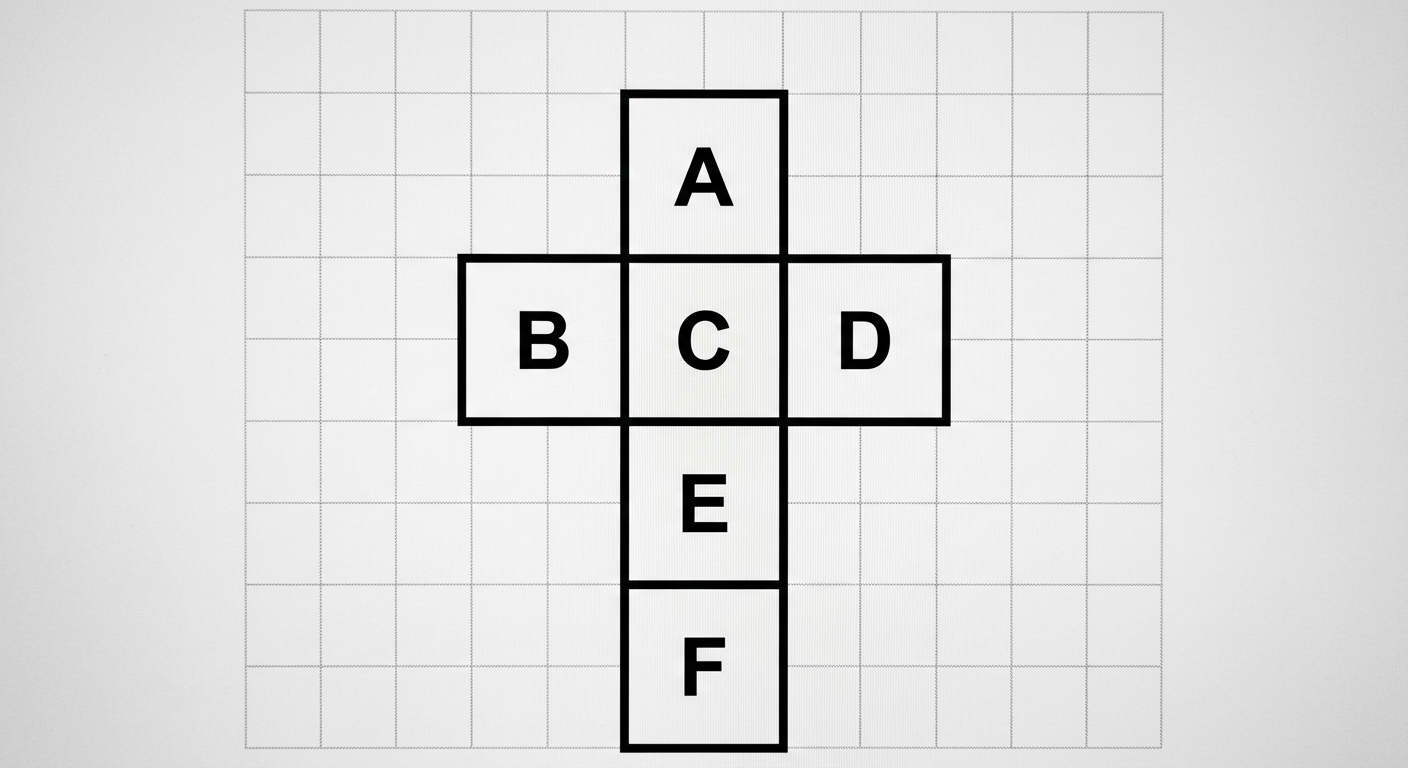
Which of the following combinations of three faces CANNOT be seen together on a single cube from any perspective?
Show Solution
- To solve this, we first need to identify the opposite faces when the net is folded into a cube.
If we designate face C as the front:
• Face B would be the left side.
• Face D would be the right side.
• Face A would be the top.
• Face E would be the bottom.
• Face F would be the back.
Therefore, the pairs of opposite faces are:
• A (Top) and E (Bottom)
• B (Left) and D (Right)
• C (Front) and F (Back)
Opposite faces can never be seen together from a single perspective. We check the given options:
• A) A, B, C: These are Top, Left, and Front. All are adjacent and can be seen together.
• B) C, D, E: These are Front, Right, and Bottom. All are adjacent and can be seen together.
• C) B, C, F: These are Left, Front, and Back. Faces C and F are opposite faces, so they cannot be seen together from any single perspective.
• D) A, D, F: These are Top, Right, and Back. All are adjacent and can be seen together.
The combination B, C, F includes two opposite faces (C and F), so this cube cannot be formed.
Show Solution
- To find the total number of cubes, we need to sum the number of cubes in each layer:
- 1. Bottom layer: A square consists of cubes.
- 2. Middle layer: A square consists of cubes. These cubes are placed on top of the bottom layer.
- 3. Top layer: A single cube consists of cube. This cube is placed on top of the middle layer.
Total number of cubes = (Cubes in bottom layer) + (Cubes in middle layer) + (Cubes in top layer)
Total number of cubes = .
The entire structure is made up of 14 cubes.
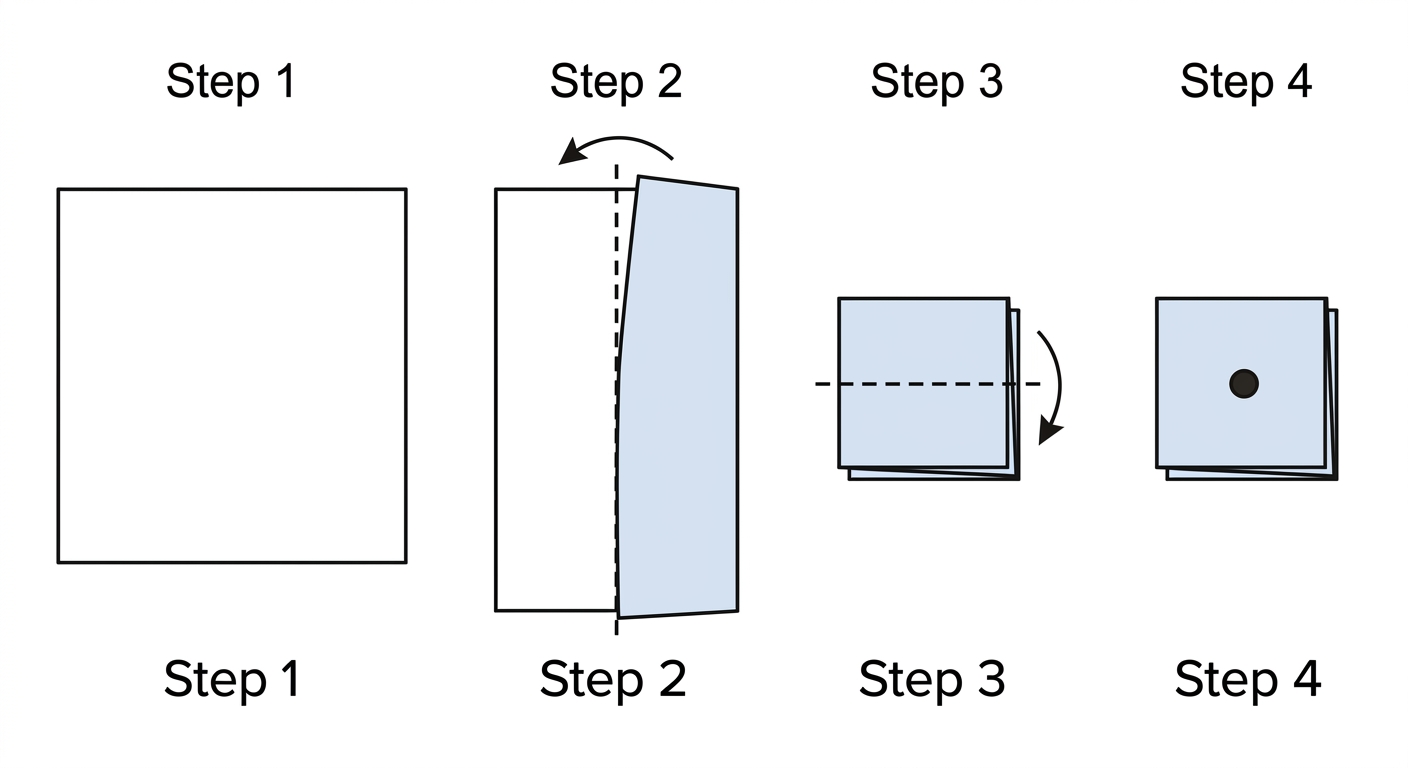
Show Solution
- Let's trace the number of layers with each fold:
- 1. Initial state: The paper is a single layer.
- 2. First fold (vertically): When the paper is folded in half vertically, one half is laid directly on top of the other. This results in layers of paper.
- 3. Second fold (horizontally): The already folded paper (which has 2 layers) is then folded in half horizontally. This means the 2 layers are doubled, resulting in layers of paper.
When a single circular hole is punched through all 4 layers, it creates a hole in each of those layers. Upon unfolding, each hole will be visible as a distinct hole on the original paper.
Therefore, when the paper is completely unfolded, there will be 4 holes.
Show Solution
- To find the number of exposed cube faces, we need to calculate the total surface area of the rectangular prism. The dimensions of the prism are:
• Length (L) = 3 cubes
• Width (W) = 1 cube
• Height (H) = 2 cubes
The formula for the surface area of a rectangular prism is .
Let's calculate each part:
• Area of the top and bottom faces: square units.
• Area of the front and back faces: square units.
• Area of the left and right faces: square units.
Total surface area = square units.
Since each exposed face is , there are 22 individual cube faces exposed to the outside.
Tips & Strategies
- Draw it out! Use your scratch paper to draw the shapes. If you are folding paper in your mind, draw the square and put little dots where the holes should go.
- Look for anchor points. If you have to rotate a shape, pick ONE feature (like a pointy corner or a dark spot) and track where that single piece goes. It is way easier than rotating the whole shape!
- Eliminate touching faces. If a problem asks which 3D cube matches a flat net, remember that opposite faces on the net can NEVER touch each other on the finished cube.
Common Mistakes
- Watch out for 'hidden' blocks! In cube-stacking problems, it is easy to only count the blocks you can see. Remember, blocks floating in the air need blocks underneath them to hold them up!
- Don't forget that left and right swap when you flip things over. If you fold a clear piece of paper, what was on the right side might end up on the left side.
Frequently Asked Questions
What if I just can't see the 3D shape in my head?
That is totally normal! Try using your pencil, eraser, or even your hand as a prop. Turn your eraser around to mimic the shape in the question.
Are there any math formulas I need to memorize for this?
Nope! Spatial reasoning is more about rules than formulas. Just remember patterns, like how folding a paper in doubles the number of layers.
What should I do if the shape rotation is too confusing?
Focus on just one small part of the shape, like a single shaded triangle. Track where that one piece goes, and cross out any answer choices where the piece is in the wrong spot.
Should I guess if I am running out of time?
Yes! The ISEE has absolutely NO penalty for guessing. If you are stuck, pick your favorite letter and move on to the next fun puzzle.