
Area, Perimeter & Composite Shapes
Calculating perimeter and area of rectangles, squares, parallelograms, trapezoids, and composite/irregular shapes — excludes circles (see circles) and triangles (see triangles)
Generate Unlimited Practice Questions
Sign up for free and get 50 practice questions to start your prep.
Start Free PracticeLearn This Topic
Imagine you are building a playpen for your new pet velociraptor 🦖. You need to know exactly how much fencing to buy so he doesn't escape, and you need to know how much grass he has to run around on. That is exactly what Perimeter and Area are all about!
Perimeter is the outside edge. It's the fence! To find it, you just add up all the outside sides. Area is the inside space. It's the grass! To find it, you multiply the length by the width. You can also think of it like a giant cake 🍰. The perimeter is the border of sprinkles around the edge, and the area is all the delicious frosting spread on top.
The ISEE test loves to ask questions about Perimeter and Area. Sometimes, they will give you a regular rectangle. Other times, they will give you a weird, chunky shape that looks like a set of stairs! When that happens, just use your math sword to chop the weird shape into normal rectangles. Find the area of each piece, and add them together. Remember, the ISEE has no penalty for guessing, so if a shape looks too crazy, take your best guess and keep moving! 🏃♂️
Practice Questions
5 practice questions for ISEE Upper Level
Show Solution
- Let the original length be and the original width be . The original area is . A increase in length makes the new length , and a decrease in width makes the new width . The new area is . Since the new area is times the original area, this represents an increase.
Show Solution
- To find the greatest possible perimeter for a given area with integer side lengths, we must find the factor pair of with the greatest difference. The factor pairs of are
(1, 60),(2, 30),(3, 20),(4, 15),(5, 12), and(6, 10). The perimeter is calculated as . Using the pair and , the perimeter is centimeters. All other factor pairs result in smaller perimeters (for example, ). Therefore, the greatest possible perimeter is cm.
Show Solution
- First, find the radius of the circle. The area of a circle is , so , which means and . The circumference of the circle (Column A) is inches. Since is approximately , is approximately inches. Next, find the side length of the square. The area is , so . The perimeter of the square (Column B) is inches. Comparing the two quantities, is greater than (since and ). Therefore, the quantity in Column B is greater.
Show Solution
- First, determine the dimensions of Square . Since its area is , its side length is . The perimeter of Square (Column A) is . Next, determine the dimensions of Rectangle . Its area is and its length is . Since Area = length width, , making the width equal to . The perimeter of Rectangle (Column B) is . Since , must be strictly greater than . Therefore, the quantity in Column B is greater.
Show Solution
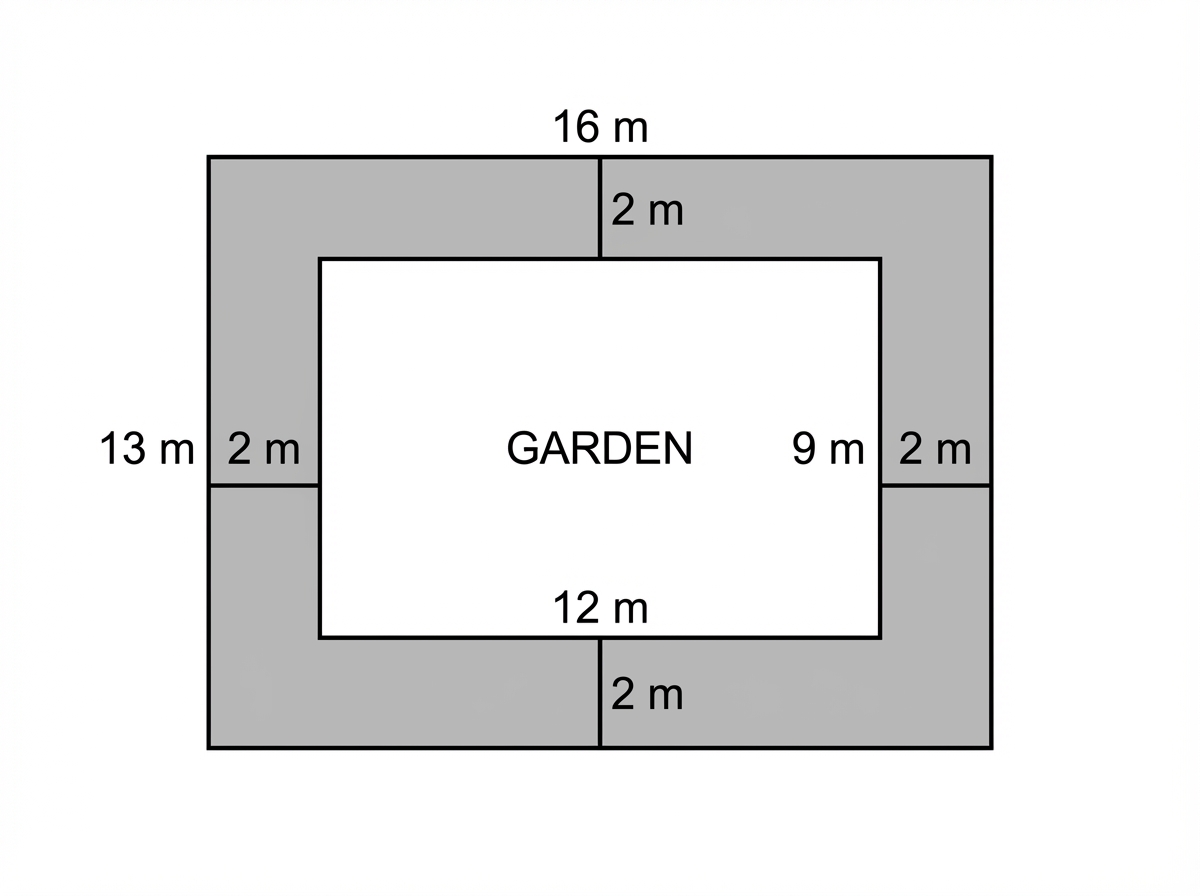
- To find the area of the walkway, subtract the area of the garden from the total area of the garden and walkway combined. The garden has an area of square meters. The walkway adds meters to each side of the garden, so the total length is meters, and the total width is meters. The combined area of the garden and the walkway is square meters. The area of the walkway alone is square meters.
Tips & Strategies
- Draw it out! ✏️ If the ISEE gives you a word problem without a picture, immediately sketch the shape on your scratch paper and label the sides.
- Look out for Quantitative Comparison traps! Sometimes the test will ask you to compare the Area in Column A to the Perimeter in Column B. Read carefully so you don't calculate the wrong thing.
- Chop up weird shapes! If you see an L-shaped room, draw a line to cut it into two normal rectangles. Find the area of both, then add them up.
Common Mistakes
- Watch out for the walkway trap! If a path goes around a garden, it adds to BOTH sides. Don't just add the width once—you have to add it twice to the length and twice to the width.
- Don't forget the when finding the area of a triangle! If you just multiply base times height, you are finding the area of a rectangle, which is a very common wrong answer choice.
Frequently Asked Questions
What's the difference between Quantitative Reasoning and Mathematics Achievement on the ISEE?
Quantitative Reasoning has the tricky Column A vs Column B questions and tests how well you think about numbers. Mathematics Achievement is more like a normal school math test where you just solve the problem!
What if I forget a formula during the test?
Don't panic! Try drawing the shape on your scratch paper. You can often estimate the answer by thinking about what makes sense. And remember, the ISEE has no guessing penalty, so always pick your best guess!
Why do the answers say 'sq ft' or 'sq cm'?
Area is measured in flat little squares! So 'sq ft' just means 'square feet'. Perimeter is just a straight line, like a string, so it uses regular feet or centimeters.
Do I need to simplify fractions on the ISEE?
Yes! The answer choices on the ISEE will almost always be in simplest form. If you get , you should look for in the choices.