
Area, Perimeter & Composite Shapes
Calculating perimeter and area of rectangles, squares, parallelograms, trapezoids, and composite/irregular shapes — excludes circles (see circles) and triangles (see triangles)
Generate Unlimited Practice Questions
Sign up for free and get 50 practice questions to start your prep.
Start Free PracticeLearn This Topic
Imagine you are building a top-secret, zombie-proof fort in your backyard! 🧟♂️ To keep the zombies out, you need to build a strong fence all the way around it. The total length of that fence is the perimeter. It is simply the distance around the outside edge of a shape. You find it by adding up all the outside lines. Easy, right?
Now, imagine you want to cover the floor of your awesome new fort with super-soft, lava-proof carpet. 🌋 The amount of carpet you need to cover the entire floor is the area. Area measures the flat space inside a shape. For a basic rectangle, you just multiply the length by the width. Think of perimeter as the crust of a pizza, and area as all the delicious cheese and pepperoni in the middle! 🍕
On the SSAT, the test makers love to test these concepts, but they might try to trick you by combining shapes or cutting pieces out of them. Don't panic! If they cut a piece out of a rectangle, just trace the new outside edges with your pencil to figure out the new perimeter. If they smash two shapes together to make a weird blob, just break it apart! Find the area of each normal shape, and then add them up. With a little practice, you will be a measurement master!
Practice Questions
5 practice questions for SSAT Upper Level
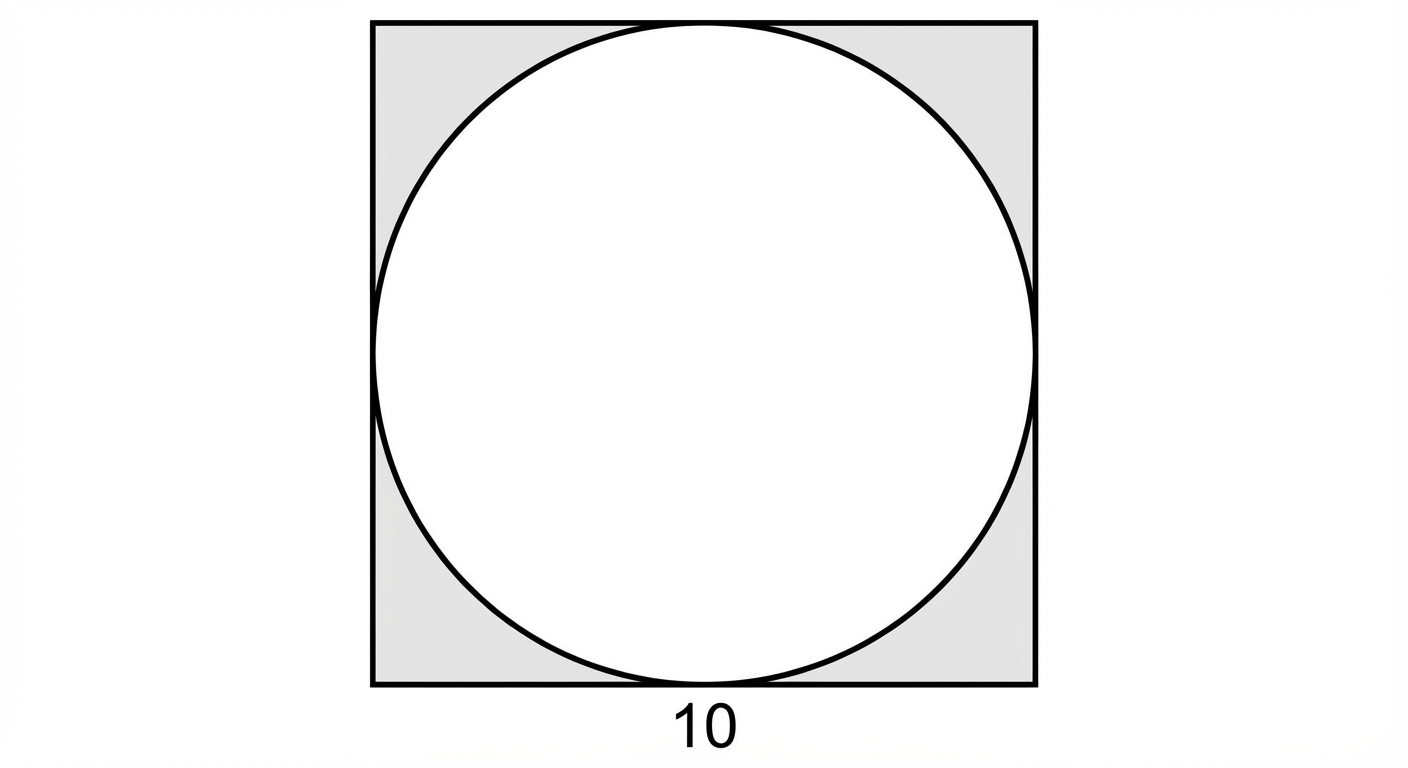
Show Solution
- First, find the area of the square. The area of a square is , so .
Next, find the area of the inscribed circle. Since the circle is inscribed, its diameter is equal to the side length of the square, which is 10. The radius is half the diameter, so .
The area of the circle is .
The area of the region inside the square but outside the circle is the area of the square minus the area of the circle: .
Show Solution
- First, find the side length of the original square. The area is 64, so , which means .
If each side is increased by 3 units, the new side length is units.
The perimeter of a square is 4 times its side length, so the new perimeter is units.
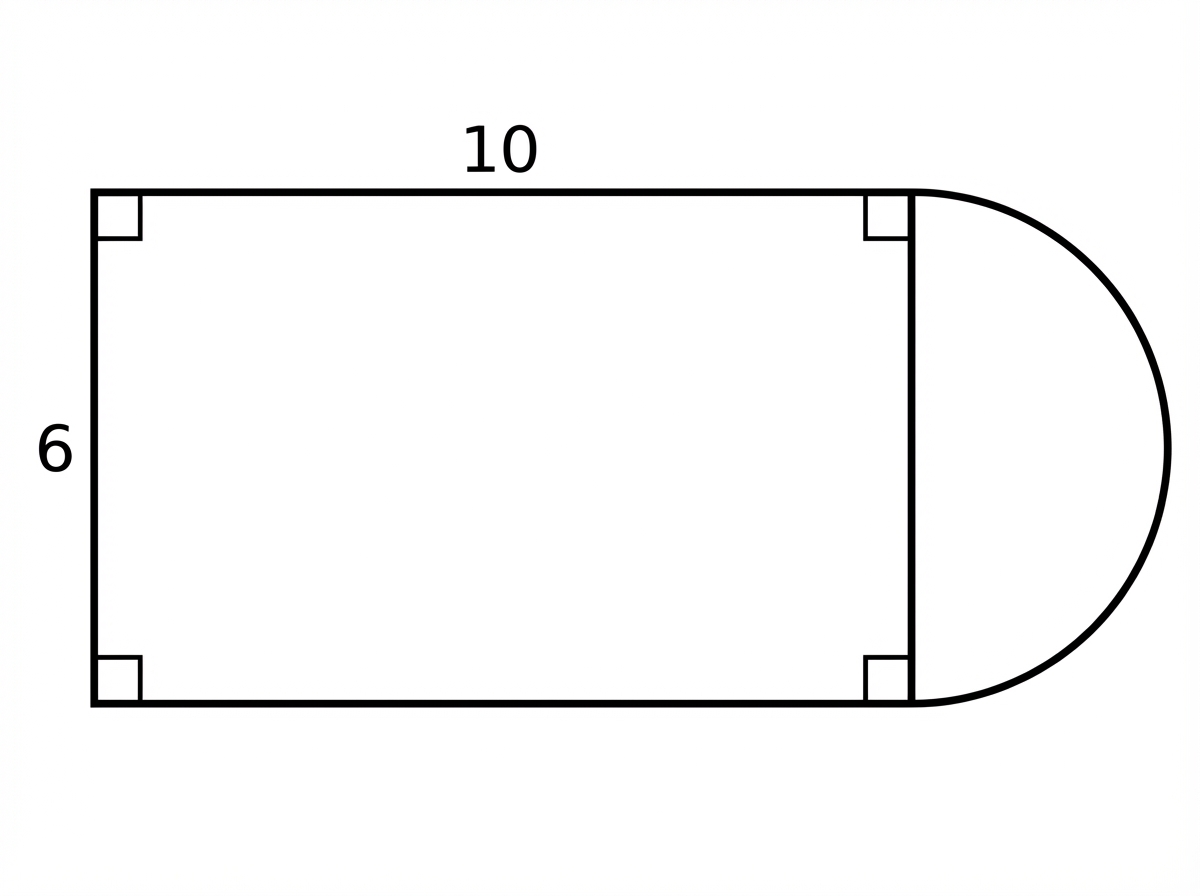
Show Solution
- The perimeter of the composite figure consists of the three outer sides of the rectangle and the arc of the semicircle. The side of the rectangle shared with the semicircle is inside the figure and does not count toward the perimeter.
The three outer sides of the rectangle are the two lengths and one width: .
The diameter of the semicircle is 6, so its circumference if it were a full circle would be . The length of the semicircular arc is half of that: .
The total perimeter is the sum of the outer rectangular sides and the semicircular arc: .
Show Solution
- The amount of fencing represents the perimeter of the rectangle. The formula for the perimeter is . We are given , so , which simplifies to .
We are also told the length is 4 meters longer than the width, so .
Substitute for in the simplified perimeter equation: .
Combine like terms: .
Subtract 4 from both sides: .
Divide by 2: .
The width is 8 meters, so the length is meters.
The area of the rectangle is length times width: square meters.
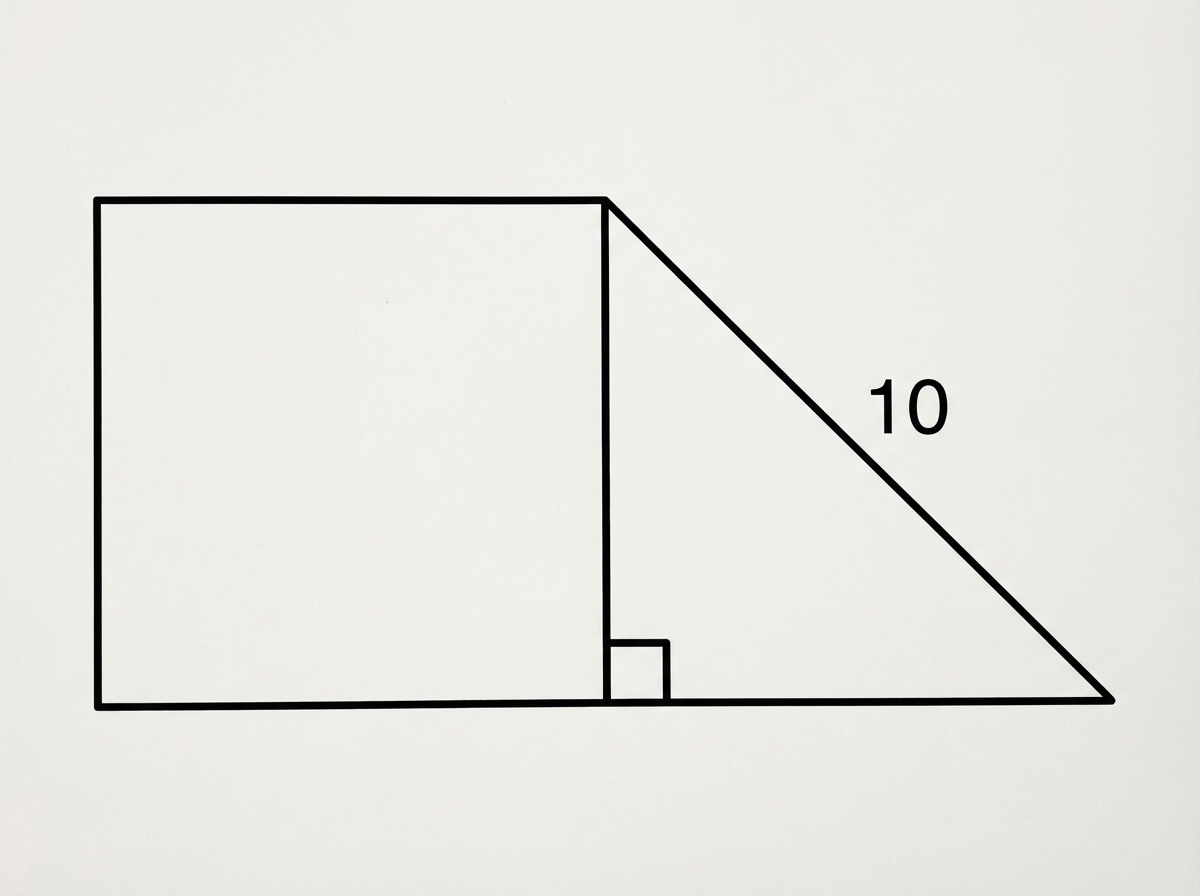
Show Solution
- First, find the side length of the square. Since the area is 36, the side length is .
This side length is also one of the legs of the right triangle. We are given that the hypotenuse is 10. We can use the Pythagorean theorem () to find the other leg of the triangle: .
.
, so . (This is a 6-8-10 right triangle, which is a multiple of the 3-4-5 right triangle).
The area of the right triangle is .
The total area of the composite figure is the area of the square plus the area of the triangle: .
Tips & Strategies
- Draw it out! The SSAT loves to give you word problems without pictures. Sketching the shape and labeling the sides prevents silly mistakes.
- Watch out for the 'add to both sides' trick. If a border goes around a whole garden, it adds to the left AND right sides, so you have to double the border width!
- Trace the perimeter with your pencil. When finding the perimeter of a weird, mashed-up shape, physically tracing the outside lines helps you make sure you didn't miss any sides.
Common Mistakes
- Watch out for mixing up the formulas! A classic mistake is multiplying when you should add (finding area instead of perimeter) or adding when you should multiply.
- Don't forget the hidden sides! When two shapes are stuck together (like a triangle on top of a square), the line where they touch is inside the new shape, so it does NOT count towards the perimeter.
Frequently Asked Questions
Do I need to memorize area formulas for the SSAT?
Yes! The SSAT expects you to know the area of squares, rectangles, triangles (Area = ), and circles. Memorize these early!
What if a shape is super weird and I don't know the formula?
Break it into smaller, normal shapes! A weird L-shape is really just two rectangles glued together. Find the area of each piece and add them up.
Why do we use 'square units' for area?
Because you are literally counting how many little squares fit inside a shape! Perimeter is just a line (like a piece of string), so it uses regular units like inches.