
Coordinate Geometry
Plotting points, distance, midpoint, and slope on the coordinate plane — excludes graphing linear equations (see linear-graphing)
Generate Unlimited Practice Questions
Sign up for free and get 50 practice questions to start your prep.
Start Free PracticeLearn This Topic
Imagine a giant treasure map with a grid covering the whole thing. That's exactly what a coordinate plane is! 🗺️ When you play video games like Minecraft, your character moves around using coordinates to find rare diamonds or build awesome castles. In math, we call this Coordinate Geometry. It's really just a fancy way of saying "finding stuff on a grid."
The grid has two main roads. The x-axis goes left and right, like a flat street. The y-axis goes up and down, like a tall elevator. Every point on the map has a special address, written as (x, y). You always walk along the flat street (the x number) before you take the elevator up or down (the y number). A great trick to remember this is: you have to run before you can jump! 🏃♂️
On the SSAT, you'll get to play detective on this grid. You might need to figure out the shape of a fenced-in yard by plotting its corners. Or, you might need to find the exact middle of a pizza delivery route (we call that the midpoint). Sometimes, you'll calculate how far a superhero flew from point A to point B (the distance). It might look tricky at first glance, but once you know how to read the map, you'll be racking up points on the test like a pro gamer! 🎮 Grab your pencils, and let's explore the math map together!
Practice Questions
4 practice questions for SSAT Upper Level
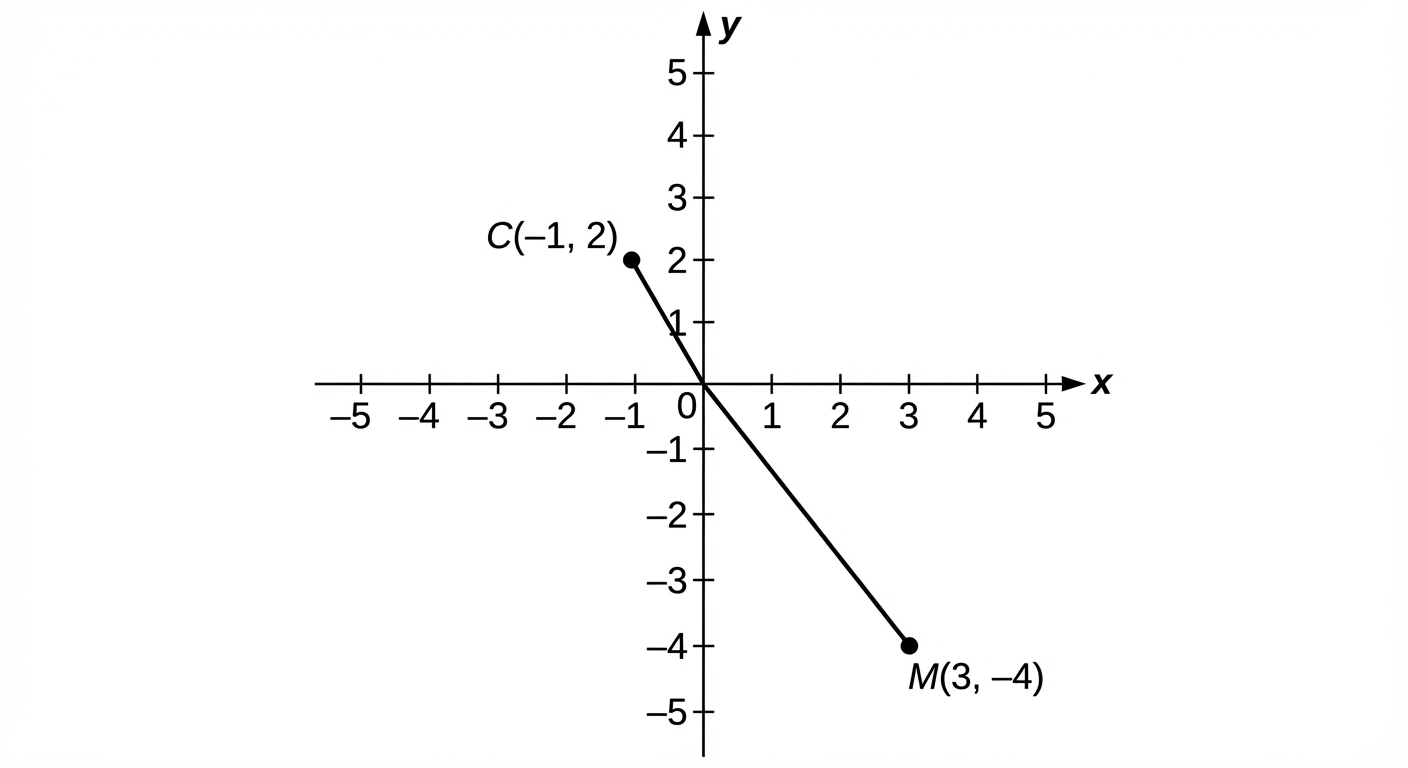
Show Solution
- To find the coordinates of an endpoint when given the midpoint and the other endpoint, use the midpoint formula: . Let the coordinates of point D be
(x, y). Set up an equation for the x-coordinate: . Multiply both sides by 2 to get , so . Next, set up an equation for the y-coordinate: . Multiply both sides by 2 to get , so . Therefore, the coordinates of point D are .
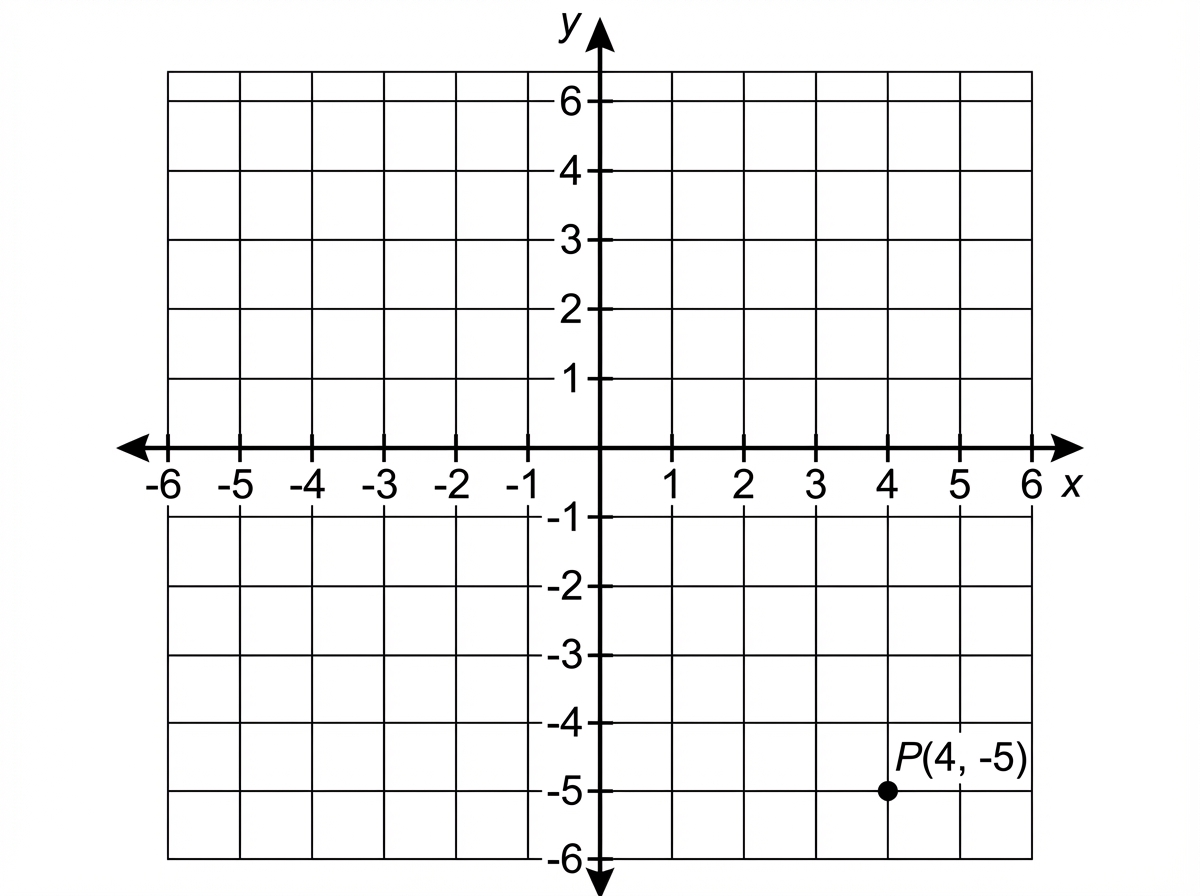
Show Solution
- First, reflect point across the y-axis. When reflecting a point across the y-axis, the sign of the x-coordinate changes, while the y-coordinate remains the same. This gives . Next, translate 3 units up (add 3 to the y-coordinate) and 2 units to the right (add 2 to the x-coordinate). The new x-coordinate is , and the new y-coordinate is . The final coordinates for are .
M(a, b) and point N(c, d) is 5 units. Which of the following pairs of points must also have a distance of exactly 5 units?(2a, 2b) and (2c, 2d) Show Solution
- The distance between two points remains unchanged if both points are translated (shifted) by the exact same amount in the same direction. Choice (B) translates both point M and point N by adding 3 to their x-coordinates and 3 to their y-coordinates. Because both points move together in the exact same way, the length of the segment connecting them remains 5 units. The other choices apply different transformations to the two points or scale the distance (as in choice C, which would double the distance).
(x, y) lies in Quadrant IV of the xy-coordinate plane, in which quadrant does the point lie?Show Solution
- If point
(x, y)is in Quadrant IV, its x-coordinate must be positive () and its y-coordinate must be negative (). We need to determine the signs of the coordinates for the new point . Since is positive, must be negative. For the y-coordinate, is a positive number minus a negative number. Subtracting a negative is the same as adding a positive, so is positive. Therefore, the new point has a negative x-coordinate and a positive y-coordinate . Points with a negative x-coordinate and a positive y-coordinate lie in Quadrant II.
Tips & Strategies
- Always draw a quick sketch! ✏️ If the SSAT asks you about a shape or distance, draw a tiny grid and plot the points. Seeing it visually often makes the answer obvious.
- Remember 'Run before you jump!' Always read the x-coordinate (left/right) first, then the y-coordinate (up/down). Mixing these up is a trap the test makers love to set.
- Look out for the 3-4-5 right triangle! When finding the distance between two points, if the x-distance is 3 and the y-distance is 4 (or vice versa), the total distance is always 5.
Common Mistakes
- Watch out for mixing up your x and y coordinates! Plotting
(2, 5)instead of(5, 2)will land you in a completely different spot on the map. 🛑 - Don't forget that distance can never be negative! Even if you subtract backwards and get a negative number, the length of a line is always a positive number.
Frequently Asked Questions
Do I need to memorize the big, scary distance formula for the SSAT?
Not necessarily! For most SSAT distance problems, you can just draw a right triangle on a grid and use the Pythagorean theorem (). It's much easier to remember and does the exact same thing!
What if my midpoint isn't a whole number?
That is totally okay! Sometimes the middle of a pizza slice is a fraction. 🍕 If your average gives you a decimal like or a fraction like , just leave it! The answer choices on the test will match your math.
Are coordinate geometry questions on all levels of the SSAT?
Yes! Lower level tests focus mostly on plotting points and identifying shapes like squares and rectangles. Upper level tests will ask you to calculate distance, midpoint, and slope.