
Linear Graphing & Slope
Slope, y-intercept, graphing linear equations, identifying graph properties, and slope-intercept form
Generate Unlimited Practice Questions
Sign up for free and get 50 practice questions to start your prep.
Start Free PracticeLearn This Topic
Imagine a magical machine in a factory. You drop in a plain piece of dough, the machine buzzes and whirs, and out pops a delicious, hot pizza! 🍕 That is exactly how a mathematical function works. It is simply a rule machine. You put a number in (the input, usually called ), the machine does some math to it, and it spits out a brand new number (the output, usually called or ).
If the machine's rule is 'add 5,' and you put in a 2, out comes a 7. Easy, right?
Now, imagine taking all those inputs and outputs and playing a giant game of Connect the Dots. That is what graphing is! 📈 We use a coordinate plane, which is just a flat grid. The x-axis goes left to right like a flat road, and the y-axis goes up and down like a tall building. Every point on the graph is a special address written as (x, y). This address shows exactly what went into the machine () and what came out ().
On the SSAT, you might be asked to plug numbers into a function machine, find the slope (how steep a line is), or figure out where a line lives on a graph. Don't worry if it looks like a secret code at first. Once you learn the basic rules of the machine, you will be a function master in no time! 🦸♂️
Practice Questions
5 practice questions for SSAT Upper Level
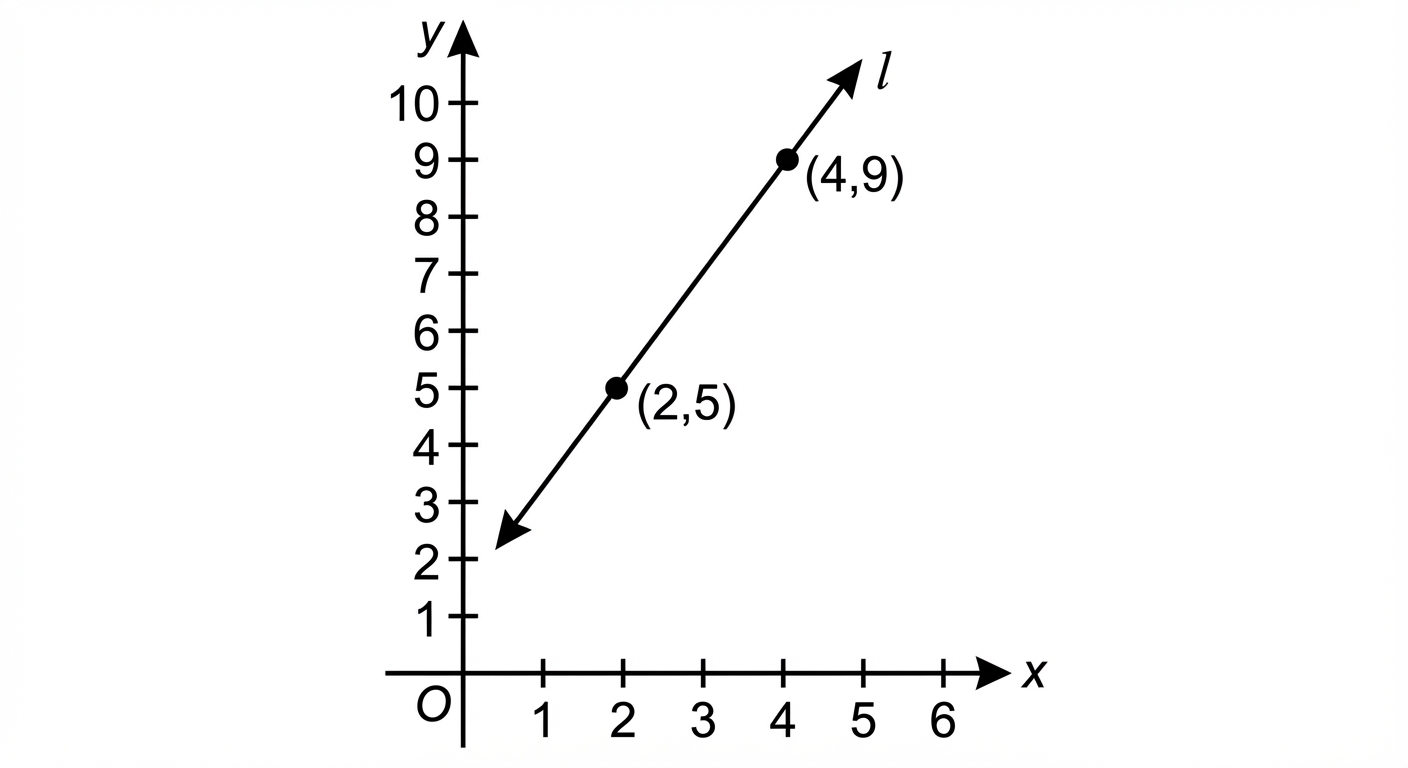
(2, 5) and (4, 9). If line is parallel to line and passes through the points and (1, y), what is the value of ?Show Solution
- First, find the slope of line using the slope formula . The slope is . Because parallel lines have the same slope, the slope of line is also 2. Now, set up the slope equation for line using its points and
(1, y): . Simplify the denominator: . Multiply both sides by 2 to get . Add 3 to both sides to find .
Show Solution
- To determine the slope and y-intercept, convert the equation into slope-intercept form (). Subtract from both sides to get . Then, divide by to get . The slope of the line is . Since both and are positive, the fraction is positive, making the slope negative. The y-intercept is . Since is negative and is positive, a negative divided by a positive is negative. Therefore, the line has a negative slope and a negative y-intercept.
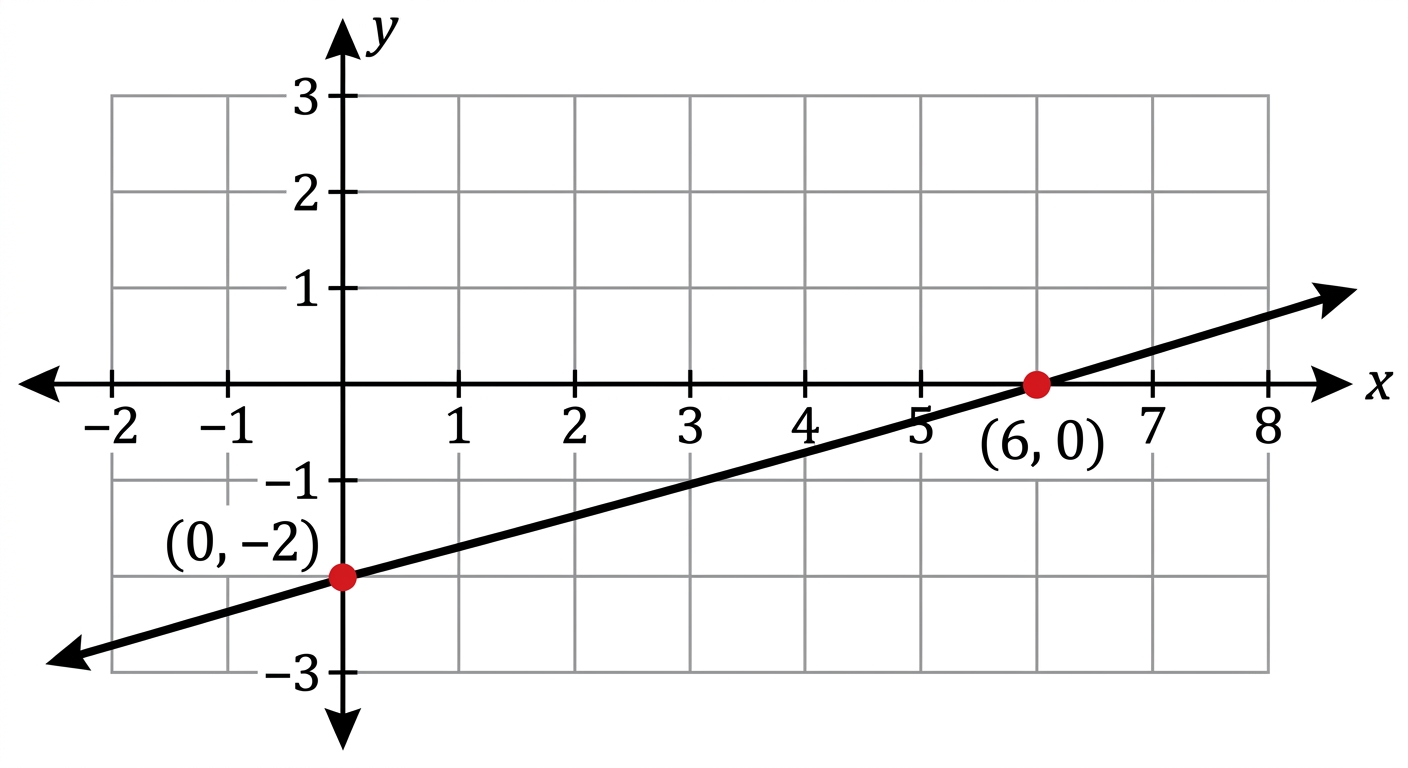
Show Solution
- The x-intercept is the point where the line crosses the x-axis, which is
(6, 0). The y-intercept is the point where the line crosses the y-axis, which is . First, find the slope using the points(6, 0)and : . Using the slope-intercept form , substitute the slope and the y-intercept . The equation is .
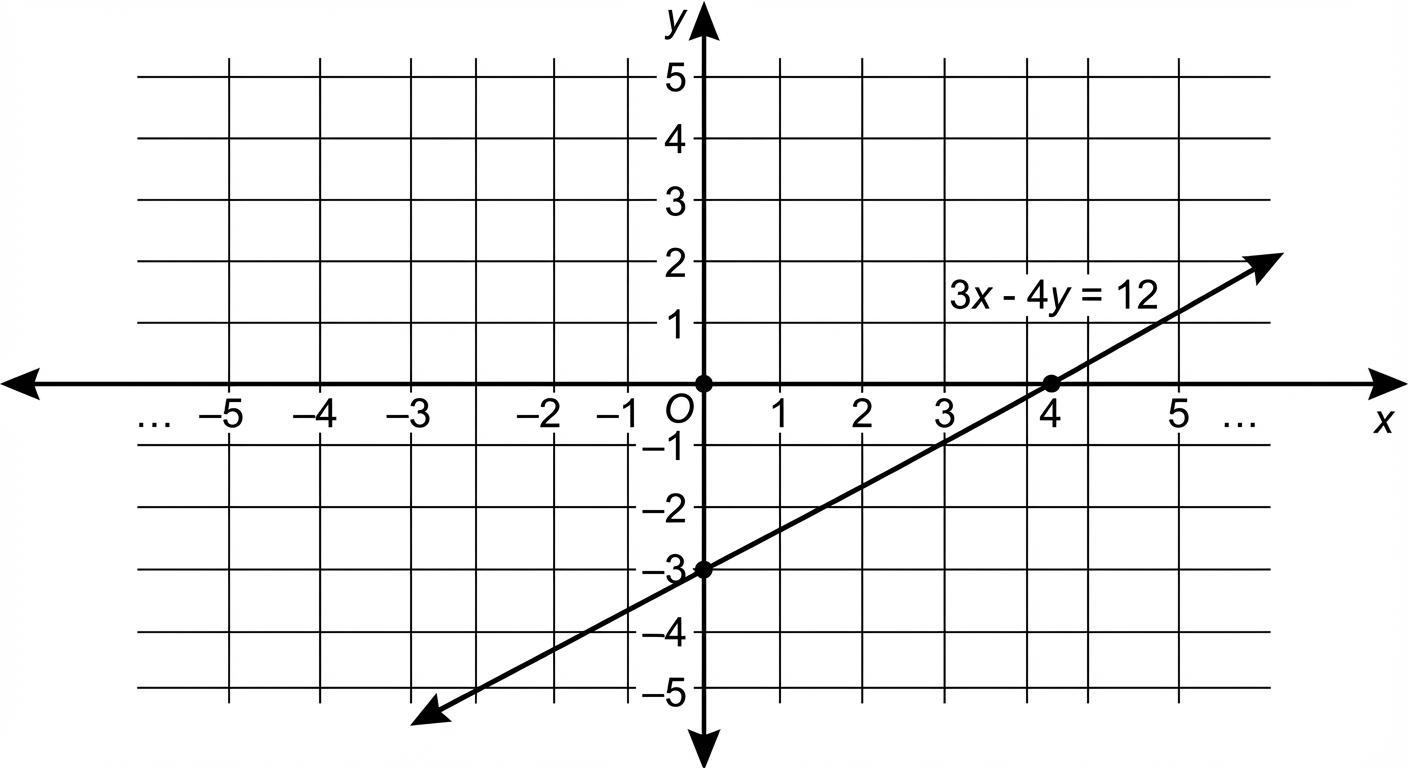
Show Solution
- First, find the slope of the given line by rewriting in slope-intercept form (). Subtract from both sides to get . Divide by -4 to get . The slope of this line is . Perpendicular lines have slopes that are negative reciprocals of each other, so the slope of the new line must be . Since the new line passes through the origin
(0, 0), its y-intercept is 0. The equation of the line is .
(4, y) has a slope of . What is the value of ?Show Solution
- Use the slope formula and substitute the given values: . Simplify the denominator to get . To solve for , multiply both sides of the equation by 6. This gives , which simplifies to . Add 5 to both sides to find .
Tips & Strategies
- When you see , don't get scared! It is just a fancy way of writing . Treat it like a set of instructions telling you exactly what number to plug into the spot. 🤖
- If a question asks which point is on a line, just plug the and values from the answer choices into the equation. The one that makes the math perfectly true is your winner! 🏆
- Always physically write labels like and above your points before using the slope formula. It takes two extra seconds and prevents silly mix-ups!
Common Mistakes
- Watch out for negative numbers when using the slope formula! If you subtract a negative number, it turns into a positive (for example, ). ⚠️
- Don't flip your x and y axis! Remember that means going left or right (walking across the floor), and means going up or down (climbing the stairs). 🚪🚶♂️
Frequently Asked Questions
What does 'f(x)' even mean?
It is read out loud as 'f of x'. It just tells you the name of the function is 'f' and the input variable is 'x'. It's exactly the same as 'y' in a regular equation!
How do I remember which axis is which?
Think of a real-life cross. The x-axis is a flat floor you walk aCross (horizontal). The y-axis is a tall tree with branches pointing up to the skY (vertical). 🌳
Will I have to draw graphs on the SSAT?
Nope! The SSAT is entirely multiple choice. You won't have to draw your own graphs, but you will need to read them, find points on them, or calculate slopes from points.
What if my slope fraction is upside down?
That's a super common error! Always remember 'Rise over Run.' The Y values (up and down) must ALWAYS go on top of the fraction, like .