
Patterns & Sequences
Arithmetic and geometric sequences, pattern recognition, and nth-term formulas — classified under algebra because the core skill is generalizing a rule, even though SSAT places it under Number Concepts
Generate Unlimited Practice Questions
Sign up for free and get 50 practice questions to start your prep.
Start Free PracticeLearn This Topic
Have you ever noticed how a staircase goes up by the exact same height every step? Or how the number of zombies in your favorite video game doubles every level? 🧟♂️ That’s a pattern! Patterns and sequences are just lists of numbers that follow a secret rule. On the SSAT, your mission is to become a math detective and crack that secret code! 🕵️♀️
There are two main types of number patterns you’ll see. The first is an "arithmetic" (air-ith-MET-ic) sequence. This is like adding the same number of pepperoni slices to every new pizza you order. If the first pizza has 3 slices, the next has 5, and the next has 7, the secret rule is just .
The second type is a "geometric" sequence. This is when you multiply to get to the next number. Imagine a magical piggy bank where your money triples every day. If you start with 2 dollars, tomorrow you'll have 6, and the next day you'll have 18. The secret rule here is ! 🐷
Sometimes, patterns aren't just adding or multiplying. You might see a pattern hiding in fractions, where the top numbers (numerators) do one thing and the bottom numbers (denominators) do another. The trick to crushing these SSAT questions is to look at the first few numbers, guess the rule, and then test it to see if it works for the whole line. You've got this!
Practice Questions
4 practice questions for SSAT Upper Level
Show Solution
- To find the terms of the sequence, multiply each preceding term by . The first term is 27. The second term is . The third term is . The fourth term is . The fifth term is . The sixth term is . Finally, the seventh term is .
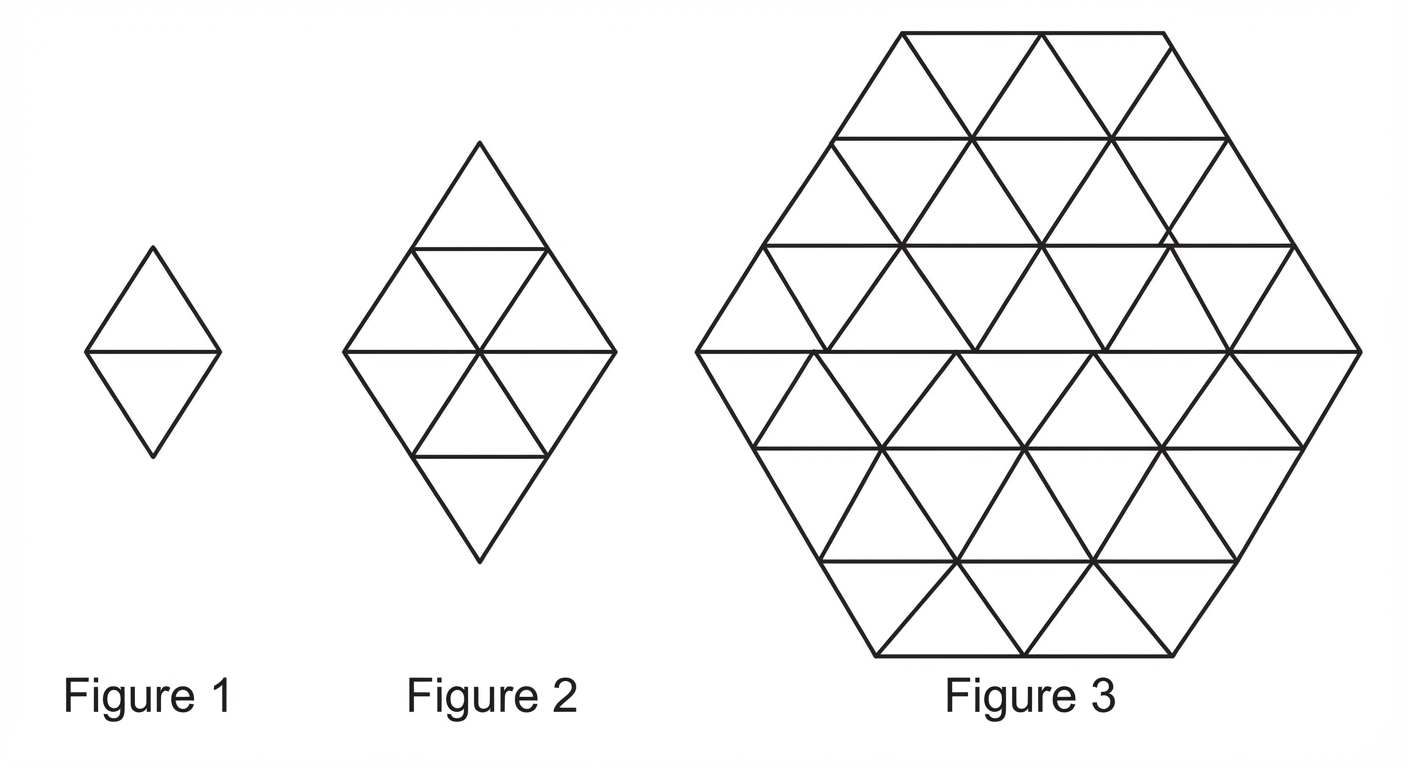
Show Solution
- Figure 1 has 2 triangles. Each subsequent figure has 4 times as many triangles as the one before it. Therefore, Figure 2 has triangles. Figure 3 has triangles. Figure 4 has triangles. Following this pattern, Figure 5 will multiply the initial 2 by 4 four times, which is represented by .
In the sequence above, the first term is , where . Each term after the first is formed by multiplying the preceding term by the same expression. What is the next term in the sequence?
Show Solution
- First, find the expression used to multiply each term by dividing the second term by the first term: . You can verify this with the next terms: . To find the next term in the sequence, multiply the last given term, 6, by the common multiplier . This gives .
Show Solution
- Calculate each term step-by-step using the given rule (multiply by 2, then subtract 1). The first term is 3. The second term is . The third term is . The fourth term is . The fifth term is .
Tips & Strategies
- Always test your secret rule on the third number in the sequence. A rule might work for the first two numbers (like ), but fail on the next one (like ).
- If a sequence of fractions looks confusing, don't panic! Split it into two separate patterns: one for the top numbers (numerators) and one for the bottom numbers (denominators).
- For 'nth term' questions, you don't need to memorize complex formulas. Just plug into the answer choices and see which one gives you the very first number in the sequence!
Common Mistakes
- Watch out for assuming a pattern is addition when it's actually multiplication. Always check at least three numbers to confirm the pattern type!
- Don't forget that sequences can go backwards! If the numbers are getting smaller, your secret rule might be subtracting or dividing.
Frequently Asked Questions
What does 'nth term' mean on the SSAT?
It's just a mathy way of saying 'any number in the line'. The 'n' stands for the position of the number, so the 1st term is when , and the 100th term is when !
Will I have to find super huge numbers like the 50th term?
Sometimes! But don't worry, you won't have to count it out one by one. The SSAT will either give you a formula, or you can find the rule and plug in .
What if the numbers go up, then down, then up again?
That's an alternating sequence! It usually means there are two different patterns mixed together, or the rule involves multiplying by a negative number.
Can I use a calculator for these on the SSAT?
Nope! The SSAT doesn't allow calculators. But the good news is that the patterns will always be numbers you can easily add or multiply in your head or on your scratch paper.