
Segments & Lengths
Segment arithmetic, midpoints, bisectors, and line segment relationships — 1D geometry without angle measurement
Generate Unlimited Practice Questions
Sign up for free and get 50 practice questions to start your prep.
Start Free PracticeLearn This Topic
Imagine a giant, delicious hot dog. 🌭 If you cut it into two pieces, those two pieces still add up to the whole hot dog! That's exactly how "Segments & Lengths" work in geometry. A line segment is just a straight line that has a clear start and end. If you place a point in the middle, you break that segment into two smaller pieces. The Segment Addition Postulate is just a fancy math rule that says "the small pieces add up to the big piece."
When you're taking the SSAT, geometry might look intimidating, but Segments and Lengths are actually some of the most fun puzzles on the test. You don't have to worry about weird angles or 3D shapes here—it's all happening on one straight line! Imagine it like a treasure map. 🗺️ Point A is your start, Point C is the treasure, and Point B is a cool tree you pass along the way. If it takes 10 steps to reach the tree, and 5 steps from the tree to the treasure, how far did you walk? steps!
What if you chop that hot dog perfectly in half? That exact middle spot is called the midpoint. A midpoint or a "bisector" cuts a segment into two equal halves. It's like sharing a candy bar with your best friend—you both get the exact same amount! 🍫 On the test, just keep your eyes peeled for those magic words, and remember: piece plus piece equals the whole thing!
Practice Questions
4 practice questions for SSAT Upper Level
Show Solution
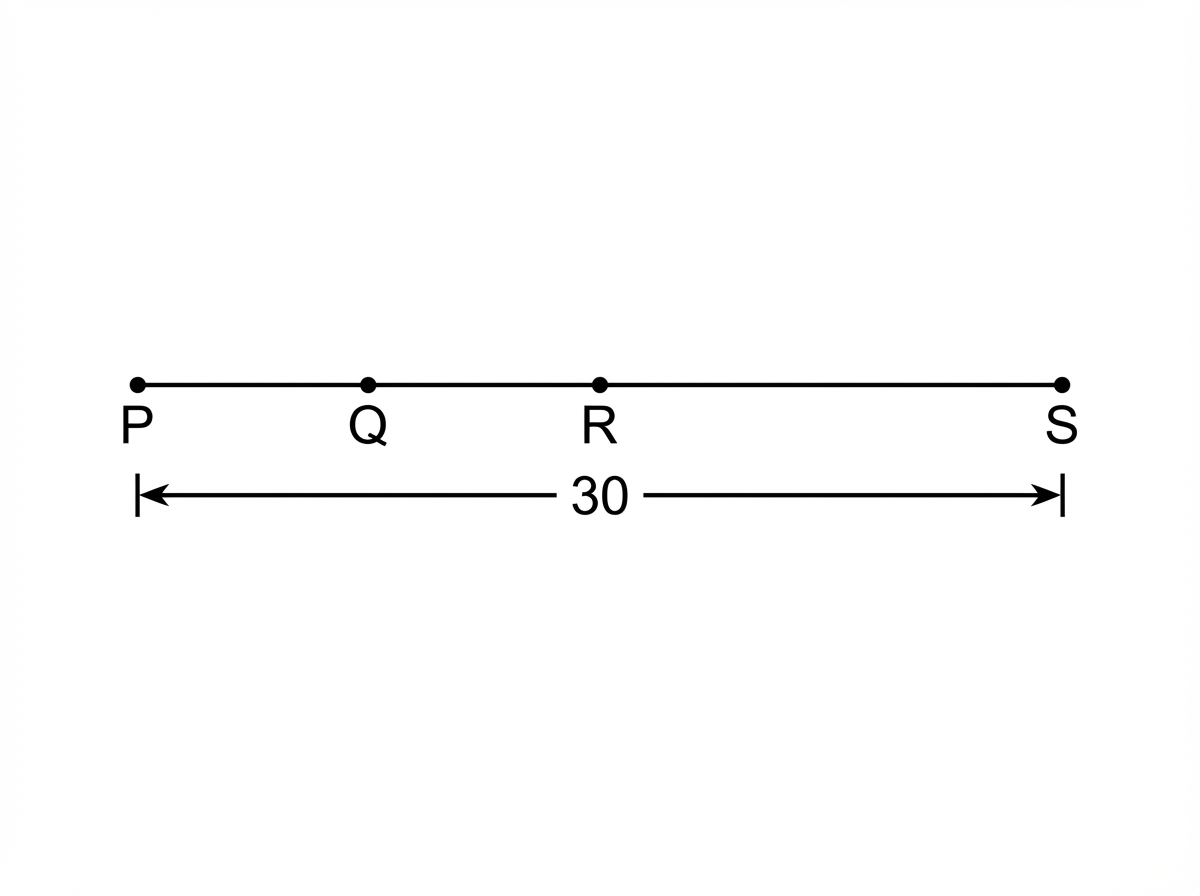
- Let the length of be . Since Q is the midpoint of , the length of is also equal to . The length of is 3 times the length of , so . The total length is the sum of its segments: . We are given that , so , which means . The question asks for the length of , which is , so the length is 6.
Show Solution
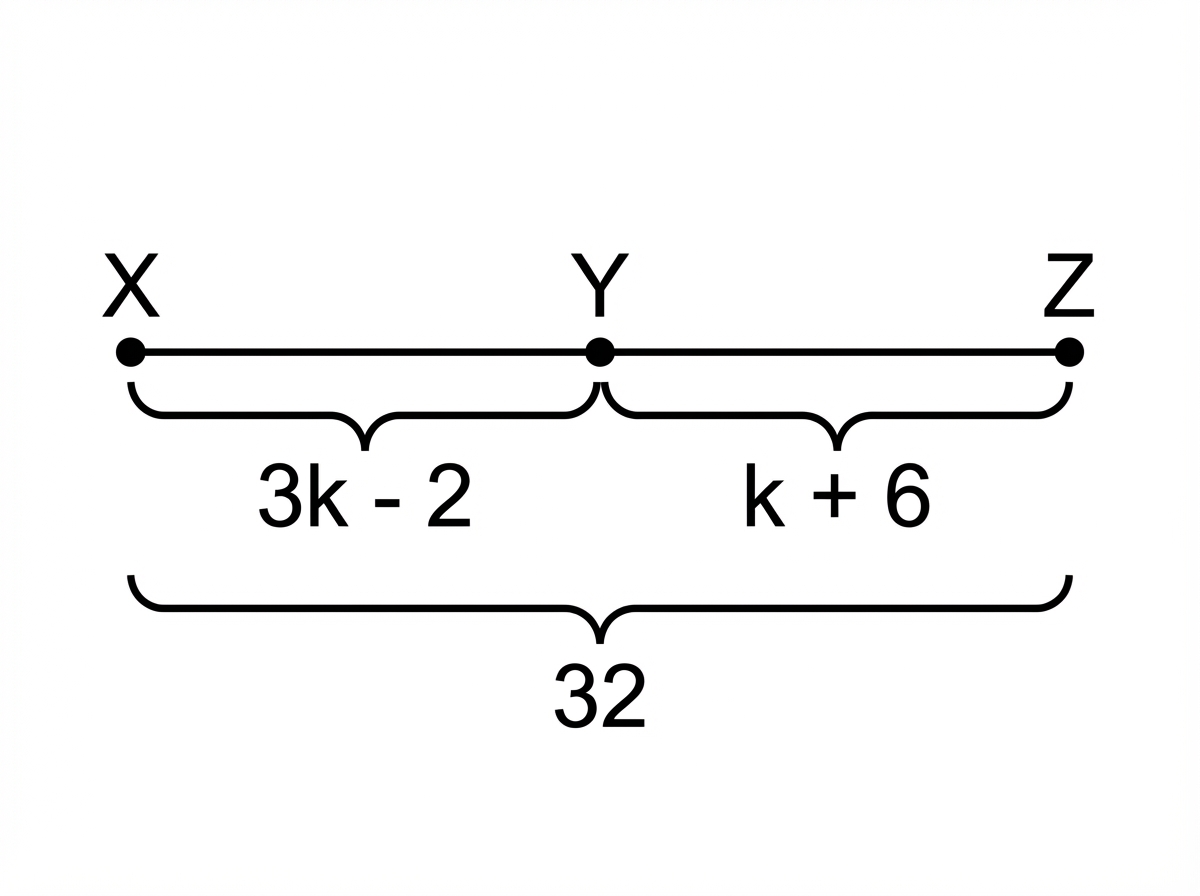
- The total length of the segment is the sum of its parts: . Substituting the given expressions, we have . Combining like terms yields . Subtracting 4 from both sides gives , so . To find the length of , substitute into the expression for : .
Show Solution
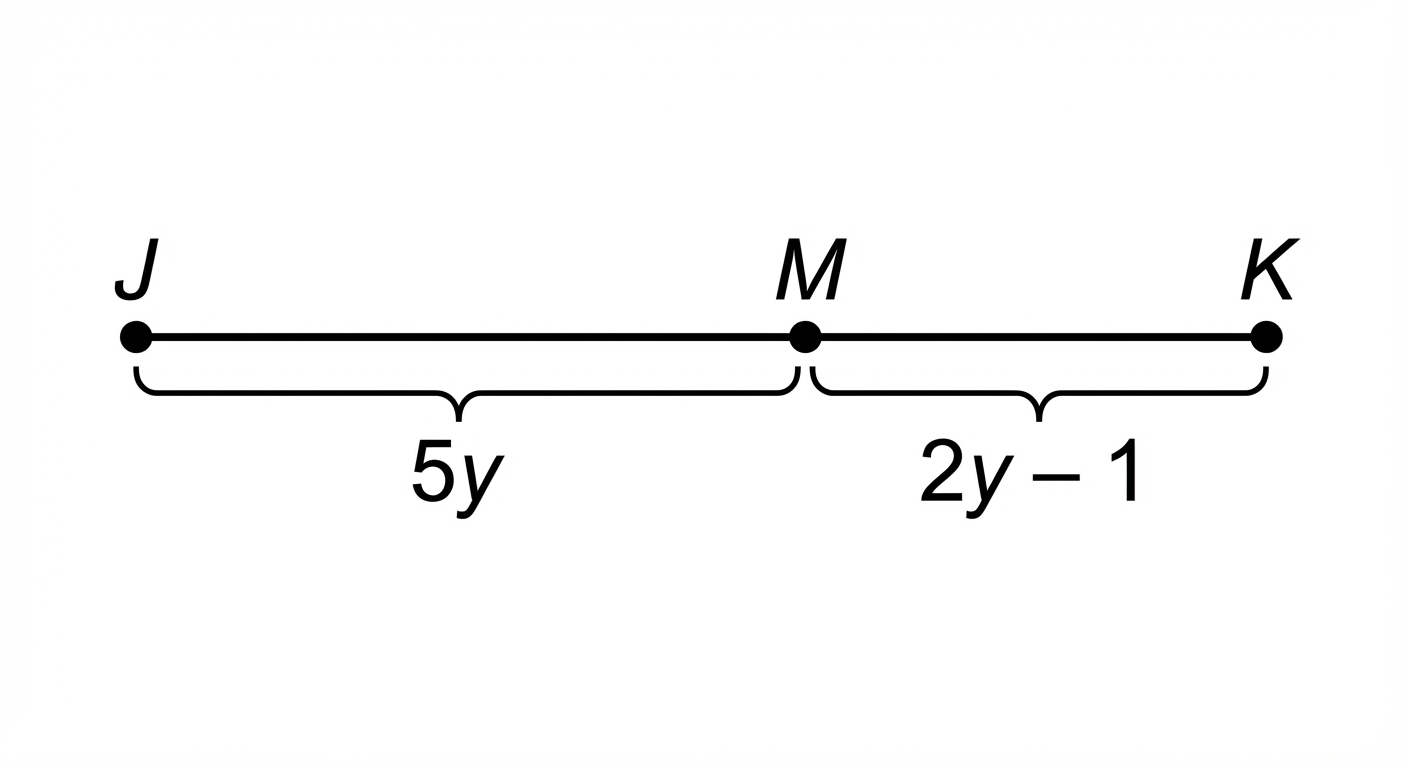
- The total length of is the sum of and . So, . This means the length of must be 1 less than a multiple of 7. Let's test the answer choices by adding 1 to each to see which results in a multiple of 7:
(A) 12 + 1 = 13
(B) 15 + 1 = 16
(C) 20 + 1 = 21 (Multiple of 7, since 7 × 3 = 21)
(D) 24 + 1 = 25
(E) 30 + 1 = 31
Only 20 fits the rule, which occurs when .
Show Solution
- Let be the distance from the boulder to the cabin. The distance from the tree to the boulder is . The total distance is the sum of these two parts: . Finding a common denominator, this becomes . Multiply both sides by to solve for : meters. The question asks for the distance from the tree to the boulder, which is meters.
Tips & Strategies
- Draw it out! The SSAT won't always give you a picture. If a question says 'Point B is between A and C', quickly draw a line with those three dots on your scratch paper. It makes the math so much easier to see!
- Hunt for the word 'midpoint' or 'bisects'. These are secret SSAT clues that mean 'divide by 2' or 'set the two pieces equal to each other'.
Common Mistakes
- Watch out for assuming a point is in the exact middle just because it's 'between' two other points. 'Between' just means it's on the line somewhere. Only assume it's perfectly in the middle if you see the word 'midpoint'!
- Don't forget to answer the actual question! Sometimes the SSAT asks you to find the value of , but other times it asks for the length of a specific segment (like 'What is the length of AB?'). Always double-check what the question wants before picking your answer.
Frequently Asked Questions
What does 'collinear' mean on the SSAT?
'Collinear' is just a fancy geometry word that means 'on the same line'. If points A, B, and C are collinear, you can draw one perfectly straight line connecting all three of them!
Will I need to use a ruler on the SSAT?
Nope! You aren't allowed to bring a ruler to the SSAT. The test questions are designed to be solved using math rules, not by measuring. Plus, the drawings on the test are often 'not drawn to scale', so measuring wouldn't help anyway!
What if a segment length comes out to a fraction?
That's totally okay! Lengths can be fractions or decimals. For example, a piece of string could easily be inches long. Just use your normal fraction math rules to solve.
What is a 'bisector'?
Think of a bisector like a karate chop right down the middle! A segment bisector is a point, line, or ray that cuts a line segment into two perfectly equal halves.